Automation Equipment
Workshop Roving Tex Acquisition and Analysis System
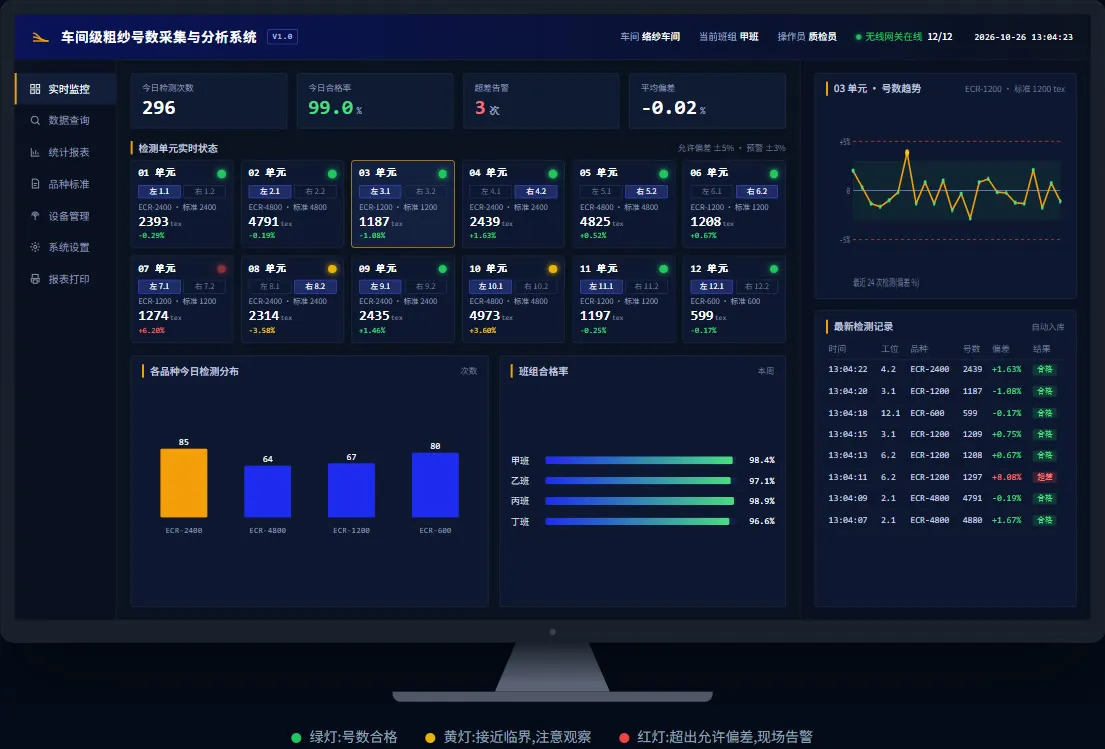
For glass fiber assembled roving workshops, 433MHz wireless acquisition replaces manual weighing records. Data is captured on weighing, product standards are matched automatically, out-of-tolerance results light a red lamp on site, and tex data is stored and reported at workshop level.
Highlights
- 12 balances connected at once, expandable
- 433MHz wireless up to 1000 m, no repeaters and no cabling
- License-free band with no monthly fees
- Product and tex standards matched automatically via the LAN server and creel switch signal
- Three-level judgment (pass / warning / out of tolerance) shown by tri-color lamps on site
- Station, time, shift, tex and deviation stored automatically; printable workshop reports
Overview
Tex is a key indicator of assembled roving quality. Catching tex deviations early allows production to be adjusted in time and avoids waste. The traditional process relies on manual cutting, weighing and recording, and with many winding units, consolidating and analyzing data is difficult:
- Scattered balance data: each balance is read separately, so consolidation takes time and analysis is slow.
- Heavy manual recording: every check requires reading and writing down the value, adding to operator workload.
- Standards checked by hand: products are matched to standards manually, which leads to copying errors and less objective data.
- No process record: without automatic records and reminders, missed checks go unnoticed and pose a quality risk.
The Workshop Roving Tex Acquisition and Analysis System replaces manual weighing records with wireless automatic acquisition: data is captured on weighing, products are identified automatically and out-of-tolerance results trigger an alarm immediately, moving tex inspection from paper records to digital quality control.
Before and after
| Item | Manual | Tex acquisition and analysis system |
|---|---|---|
| Data acquisition | Manual reading, paper records | Stable reading taken automatically when yarn is placed |
| Product and standard | Looked up and checked by hand | Matched automatically via server + switch signal |
| Judgment | Deviation calculated by hand | Tex and deviation calculated and judged instantly |
| Alerts | Relies on people noticing | Red lamp lights on site when out of tolerance |
| Traceability | Searching paper records | Query by time / station / shift / product |
| Statistics | Manual summaries | Workshop reports generated automatically, printable |
Key advantages
- Remote real-time acquisition: hardware and software together capture weighing data from 12 balances in real time; the result is taken once the balance is stable, so operators can leave as soon as the yarn is placed.
- 433MHz wireless: spread-spectrum modulation for long range and low power; no cabling, new devices work once installed, with no wiring hazards.
- Automatic standard matching: connects to the LAN server and uses the left / right creel signal from the control box switch to get the product model and tex standard, with no manual checking and fewer copying errors.
- On-site alarm when out of tolerance: when tex deviation exceeds the allowed range, the PC sends a command to light the red lamp on the corresponding control box, so the problem shows up on site right away.
- Automatic storage: station number, time, shift, tex result and deviation are written to the database; each unit has a unique device ID, giving a clear and complete record.
- Workshop-level statistics: reports customized to workshop needs, multi-dimensional queries by time, station, shift and product, with report generation and printing; UPS protects data against power loss.
Architecture
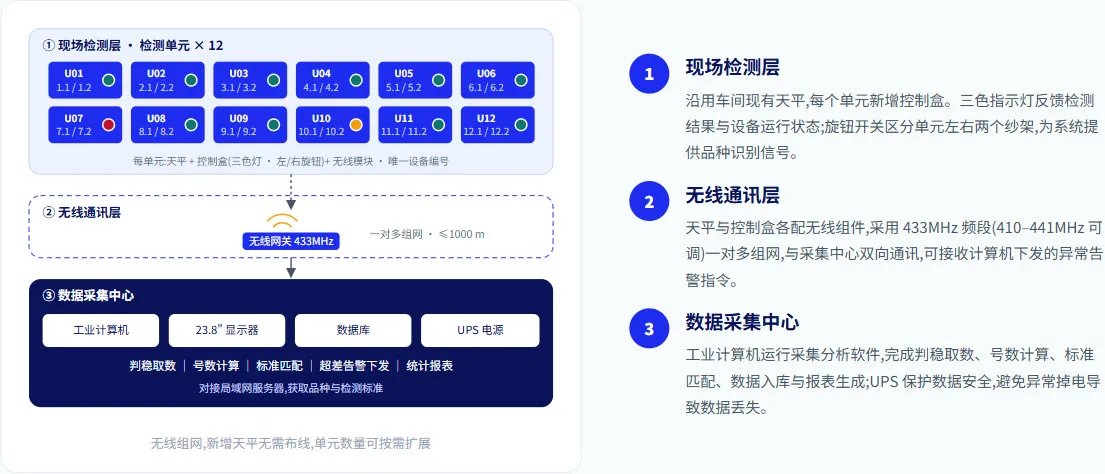
Adding control boxes, wireless modules, an industrial PC and a UPS to the existing balances completes the digital upgrade.
- Field inspection layer: the workshop’s existing balances are kept, and each unit gets a control box. Tri-color lamps show results and device status; a switch distinguishes the left and right creels of each unit, giving the system a product identification signal.
- Wireless layer: balances and control boxes each have a wireless module, networked one-to-many on 433MHz (adjustable 410–441MHz) with two-way communication to the acquisition center, so alarm commands from the PC can be received.
- Data acquisition center: the industrial PC runs the acquisition and analysis software for stable reading, tex calculation, standard matching, storage and reporting; the UPS protects data against unexpected power loss.
Communication options compared
| Item | Wired | GPRS / 4G | WiFi / ZigBee | 433MHz wireless (this system) |
|---|---|---|---|---|
| Cabling | Required, costly | Not needed | Not needed | Not needed |
| Range | Limited by cable | Depends on base stations | Shorter | Up to 1000 m |
| Communication fees | None | Monthly fees | None | License-free band, no monthly fee |
| Adding devices | Cumbersome | Moderate | Moderate | Works once installed |
| Wiring safety | Hazards exist | None | None | No wiring hazards |
Operation
Operators only do three things; the system handles the rest:
- Clean the balance: clean the balance surface so debris does not affect the result
- Set the switch: turn the switch left or right according to the creel the yarn comes from
- Weigh and go: place 1 m of cut yarn on the balance, then leave
- Judgment and storage: the system takes a stable reading, calculates tex, matches the product standard and stores it with time, shift and deviation
- Alarms and queries: out-of-tolerance results light the red lamp; managers query results by multiple criteria
Tex is the mass in grams of 1000 m of yarn. The system converts the stable weight of 1 m of yarn automatically: for example, 2.412 g means 2412 tex, which is then compared with the product’s standard value to get the deviation.
Three-level judgment
Each weighing result is judged against the product standard and shown on the tri-color lamp of the corresponding control box. Thresholds can be configured per product in the software.
| Level | Lamp | Meaning |
|---|---|---|
| Pass | Green | Tex deviation within the allowed range; result stored automatically |
| Warning | Yellow | Deviation near the limit; watch for process fluctuation |
| Out of tolerance | Red | Deviation beyond the allowed range; the PC lights the red lamp and counts the alarm |
Software
The main screen shows creel, product, standard, measured tex and deviation for all 12 units in real time; clicking a unit shows its tex trend.
- Live monitoring: status of all 12 units on one screen, with lamps, creel, product, tex and deviation refreshed in real time.
- Data query: query tex results by time, station, shift, product and other criteria.
- Reports: workshop-level tex reports designed to workshop needs, showing pass rate, deviation distribution and trends.
- Product standards: gets product models from the LAN server and links them to tex standards and allowed deviation.
- Device management: unique device ID per unit, online status visible, alarm commands can be sent to a specific control box.
- Printing: query results and reports can be generated and printed for workshop quality records.
Delivery and service
Full delivery from requirements analysis and system design to on-site deployment and training, in about 2 months (requirements 1 week, design 2 weeks, development 4 weeks, testing 2 weeks, deployment and training 1 week). On-site installation, commissioning and operator training are included, reports are customized to workshop needs, and one year of hardware and software maintenance and upgrades is provided after go-live.
Notes
The above is the standard configuration with 12 balance units; the number of units can be expanded to fit the workshop. The solution includes hardware selection and integration plus custom software development. Balance models and communication interfaces need to be confirmed on site; the final configuration is subject to the contract technical appendix. Screenshots are concept designs with simulated data; the ±3% warning and ±5% limit shown are demonstration values, and actual thresholds follow each product’s standard.
Gallery
Have an inspection challenge?
Tell us about your product and requirements. Our engineers will assess feasibility.