Inspection Systems
Warp-Knitted Fabric Online Defect Inspection System
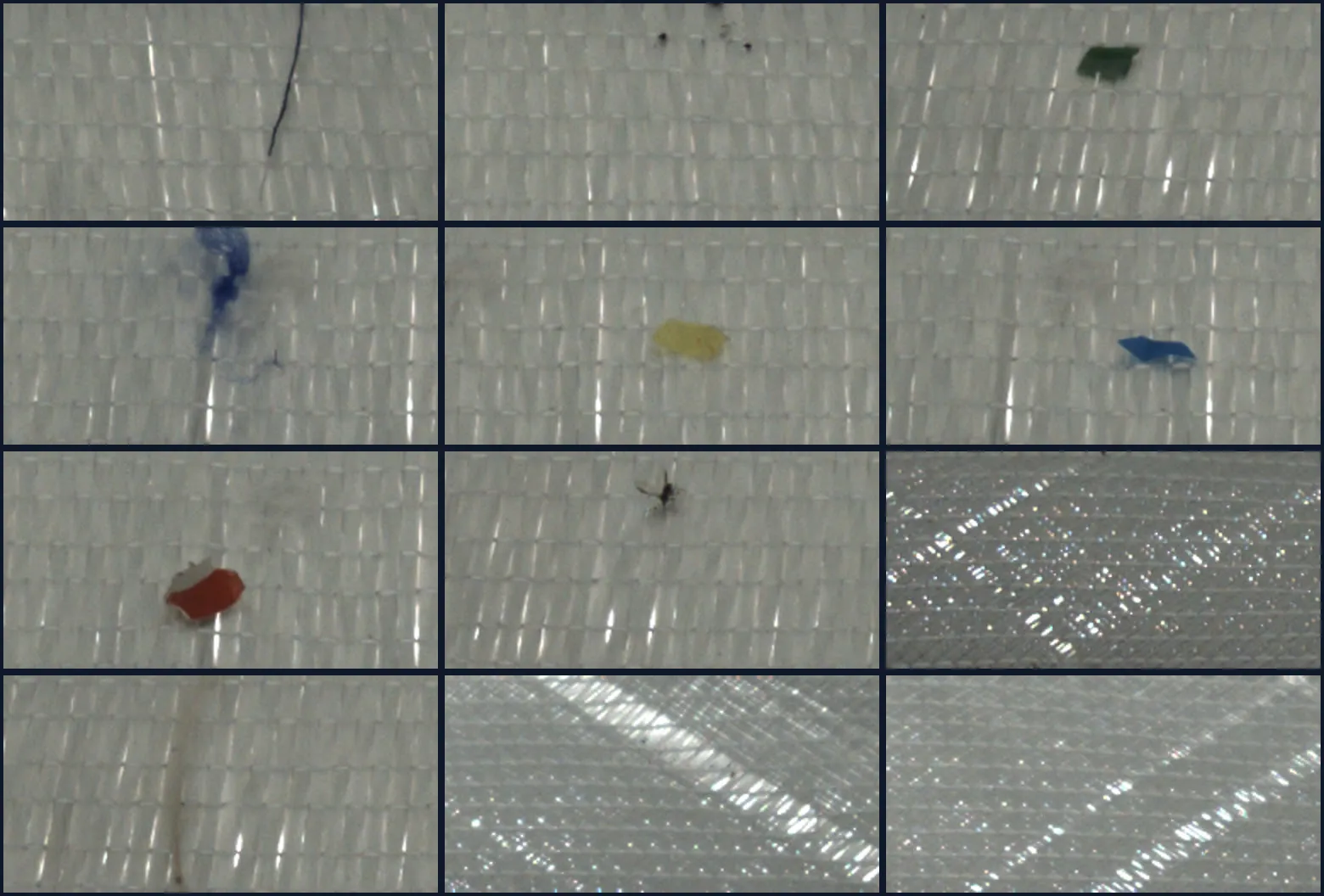
For glass fiber and carbon fiber multiaxial warp-knitted fabric lines, it scans both sides across the full width, identifies 10 defect types with machine vision and deep learning, raises real-time alarms and traces every defect by meter mark, replacing manual patrol inspection.
Highlights
- 6 color industrial cameras on the front + 6 on the back, both sides inspected simultaneously
- 0.2 mm/pixel spatial resolution, defects ≥1 mm detectable, continuous full-width coverage
- Classic image processing for screening + lightweight deep learning for classification, 10 defect types
- CPU-only inference on a multi-core industrial PC, no GPU required
- Graded alarms and line stop interlock, ≤200 ms from detection to alarm
- Meter mark, cross-direction position, type, grade and original image recorded for every defect
Overview
Multiaxial warp-knitted fabrics are widely used in key composite parts for wind turbine blades, automotive lightweighting and ships. Fabrics are wide, output is high and downstream requirements are strict, so a single missed defect can mean a scrapped roll or a customer complaint. Most lines still rely on visual inspection:
- Wide fabric, many blind spots: at 2–3.5 m wide, the eye cannot cover the whole width, and attention drops over long shifts.
- Limited coverage: visual sampling covers about 60%–70%, and detection and judgment vary by operator.
- High value per roll: a roll can be worth tens of thousands of yuan, so escaped defects multiply losses with output.
- Harsh environment: glass fiber dust is bad for operator health, making long patrol shifts hard to sustain.
The Warp-Knitted Fabric Online Defect Inspection System replaces manual patrols with machine vision and deep learning. It scans both sides across the full width, identifies defects in real time, raises alarms immediately and keeps a full trace.
Compared with manual inspection
| Item | Manual inspection | Online inspection |
|---|---|---|
| Coverage | About 60%–70% (sampling) | Continuous full width |
| Sides | Usually front only | Front and back simultaneously |
| Consistency | Varies by operator | Uniform algorithm criteria |
| Fatigue and blind spots | Significant | Continuous, no fatigue |
| Traceability | Difficult | Meter mark + cross position + image |
| Quality statistics | Manual records | Automatic statistics, trends and reports |
Key advantages
- Two-sided inspection: 6 cameras per side, staggered 200–400 mm along the running direction so the light paths do not interfere; back-side defects are detected as well.
- Full width at high resolution: 6 cameras stitched across a field of about 2.94 m, fitting 2.4–2.85 m fabric, with stable detection of defects ≥1 mm.
- AI recognition: classic image processing screens candidates and lightweight deep learning classifies them; color imaging separates color defects such as dirty yarn and colored threads.
- Speed headroom: line-scan mode reaches about 100 fps while current conditions need only 5 fps, leaving room for faster lines.
- CPU-only inference: a multi-core industrial PC handles real-time inference with lower hardware cost, power and cooling, and no GPU driver or CUDA maintenance.
- Line integration: takes new roll, running and speed signals and outputs stop, audible/visual alarm and lighting control; joints are only recorded by meter mark, without alarms or stops.
Architecture
- Image acquisition: 12 color global-shutter cameras with low-distortion lenses and IP65 housings; 2 high-CRI white LED strobe lights per side, triggered by encoder / line speed.
- Edge computing: an industrial PC takes the front and back data streams on two separate gigabit NICs for pre-processing, AI inference, defect location and storage; the two sides are networked separately so a fault on one does not affect the other; UPS protects against power loss.
- Application and interfaces: live view, defect management, reports and model management in one platform; audible/visual alarms, PLC stop interlock and reserved MES reporting.
Workflow
- Synchronized capture: encoder / line speed triggers cameras and strobe lights together
- Pre-processing: channel separation, contrast enhancement, ROI cropping and cross-direction stitching
- Candidate screening: adaptive thresholding + morphology extract suspicious regions
- AI classification: a lightweight CNN outputs 10 labels, with size measurement and confidence filtering
- Response and traceability: graded alarms / stop interlock, with defect data and images stored
10 defect types, graded response
Defects are graded by production impact, and the alarm, prompt and stop action of each grade can be switched in the software.
| Grade | Defects | Default response |
|---|---|---|
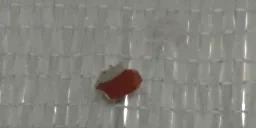
| A severe | Tape, gap, dirty yarn, colored thread | Alarm, optional line stop |
| B moderate | Stain, fuzz ball | Alarm prompt |
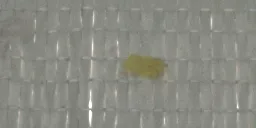
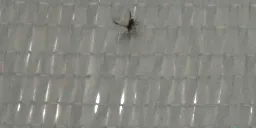
| C minor | Insect, wood chip, paper scrap | Record and prompt |
| Process feature | Joint | Meter mark recorded only, no alarm or stop |
Software
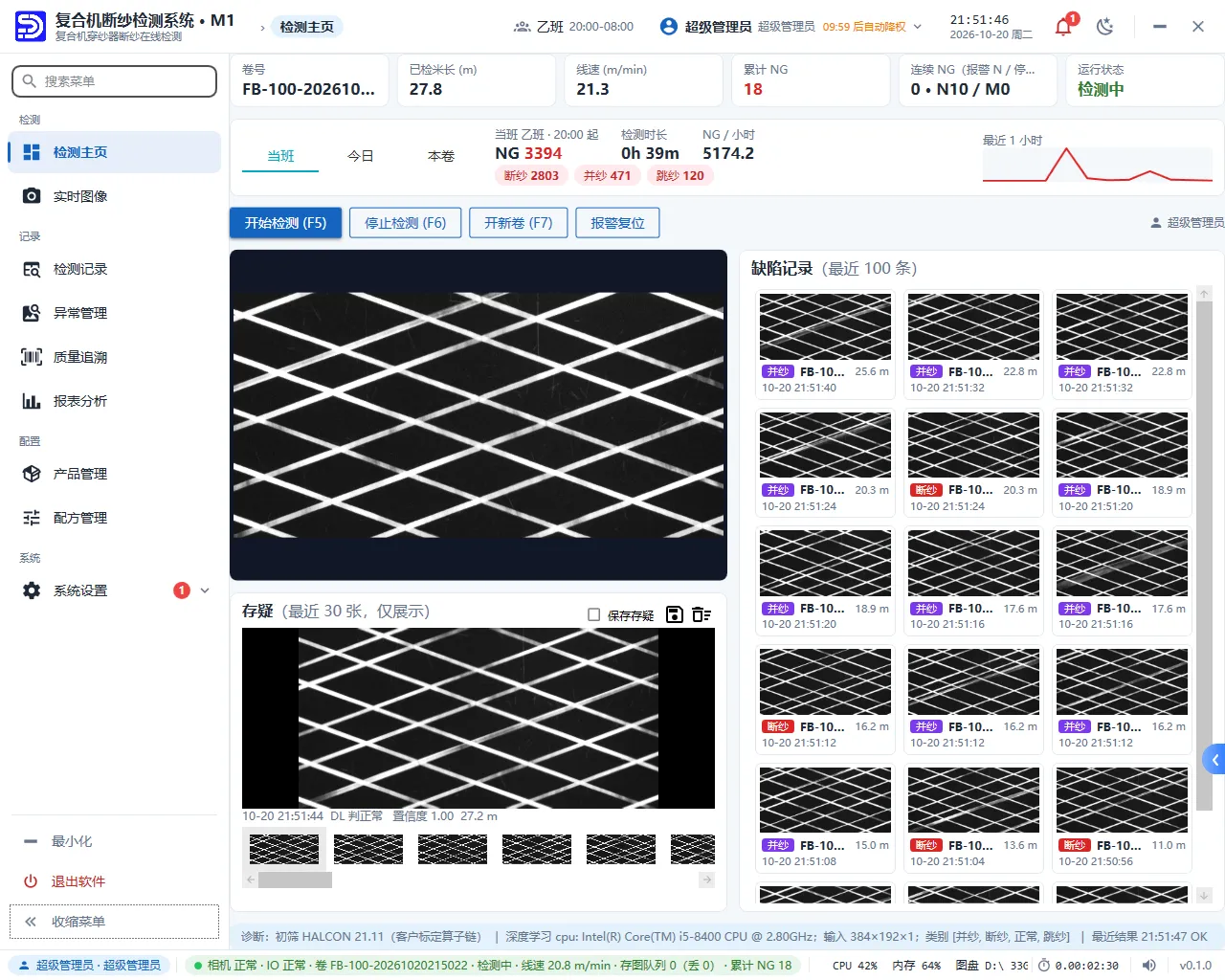
- Live inspection: 12 camera views side by side with defects overlaid in real time, meter mark and status always visible; Class A defects flash red with a buzzer.
- Defect management: filter by time, type and grade; view original images, annotations and meter marks; confirm or reject by manual review.
- Reports: statistics by shift / day / week / month, defect type distribution and density trends, export to Excel / PDF.
- Model management: training data matched to model versions; start training, deploy and roll back.
- Parameters: defect thresholds, ROI and the response for each grade adjustable without code changes.
- Access and monitoring: operator / engineer / administrator roles with audit logs; online monitoring of cameras, lighting, disk and network.
Delivery and service
Full delivery from site survey and factory acceptance test (FAT) to site acceptance test (SAT), with continued sample collection and model iteration after go-live. 12-month warranty, remote response ≤4 hours during warranty, and key spare parts such as cameras and lights supplied for ≥5 years.
Notes
The above is the standard configuration; width, speed and other parameters can be recalculated for site conditions. Miss and false alarm rates are achieved after training on ≥200 defect samples per type; final values are subject to the contract technical appendix and site acceptance.
Gallery
Related products
 Product video1:34
Inspection Systems
Yarn Break Inspection System for Laminating Machines
Installed at the yarn guide station of a laminating machine, it uses an industrial camera and vision algorithms to detect broken, merged and skipped yarns in fiberglass / polyester scrim inline, triggers alarms and machine stops, and keeps full roll-level traceability.
- Line speed
- 0–20 m/min
- Alarm response
- ≤100 ms
Details
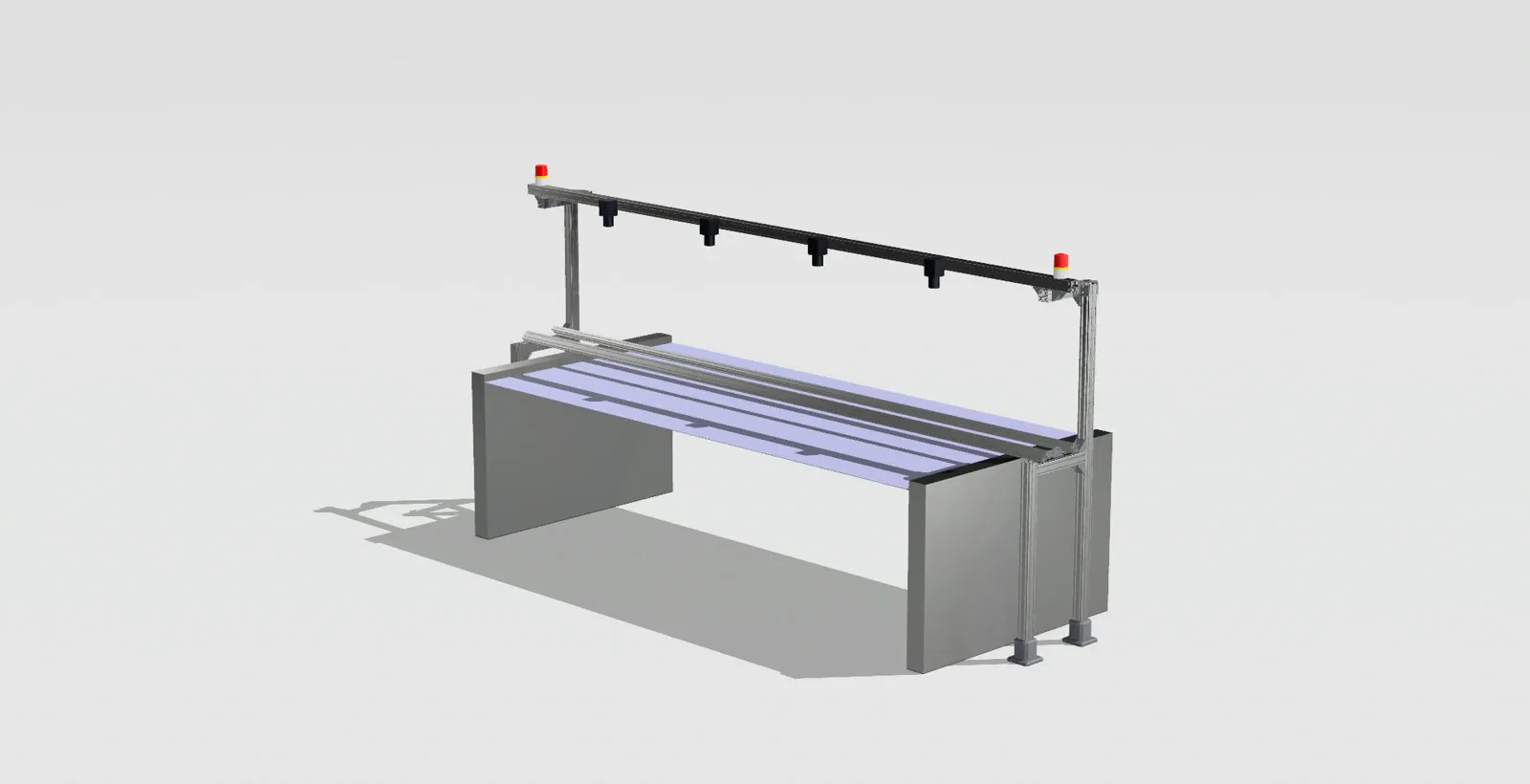
Inspection Systems
Stenter Fabric Defect Inspection System
Installed at the stenter or other finishing stations, it uses industrial cameras, LED lighting and deep learning to detect holes, pulled threads, color spots and other defects on mosquito net greige and mesh fabric inline, with graded alarms, automatic marking and roll-level traceability.
Details
Inspection Systems
UD Fabric Online Defect Inspection System
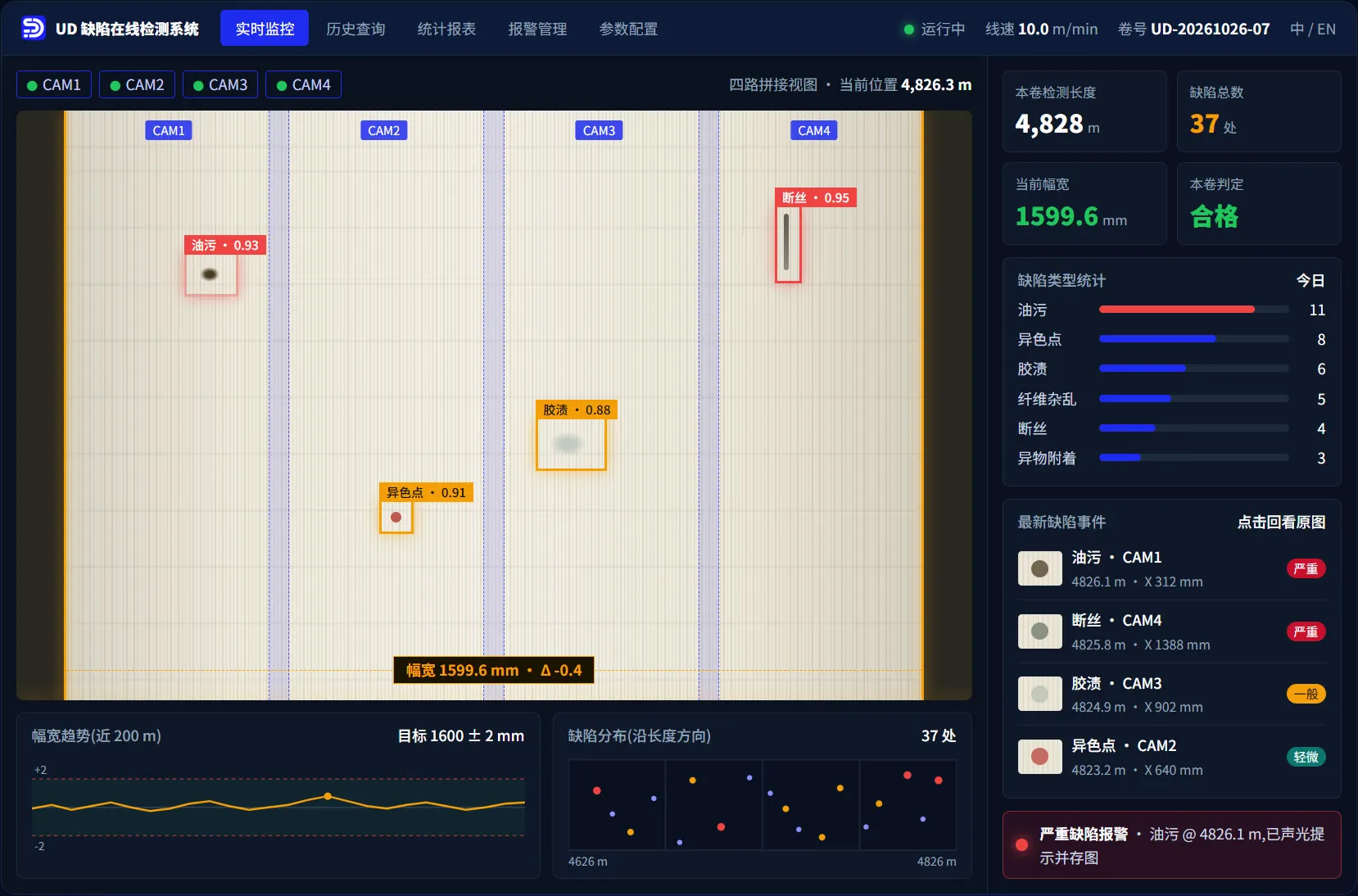
For continuous unidirectional (UD) fabric lines, 4 stitched cameras image the full width while machine vision and deep learning inspect surface defects and measure width at the same time, with real-time alarms and meter-based traceability, replacing manual sampling.
- Fabric width
- About 1.6 m
- Pixel size
- About 0.2 mm/pixel
Details
Have an inspection challenge?
Tell us about your product and requirements. Our engineers will assess feasibility.