Inspection Systems
Stenter Fabric Defect Inspection System
Installed at the stenter or other finishing stations, it uses industrial cameras, LED lighting and deep learning to detect holes, pulled threads, color spots and other defects on mosquito net greige and mesh fabric inline, with graded alarms, automatic marking and roll-level traceability.
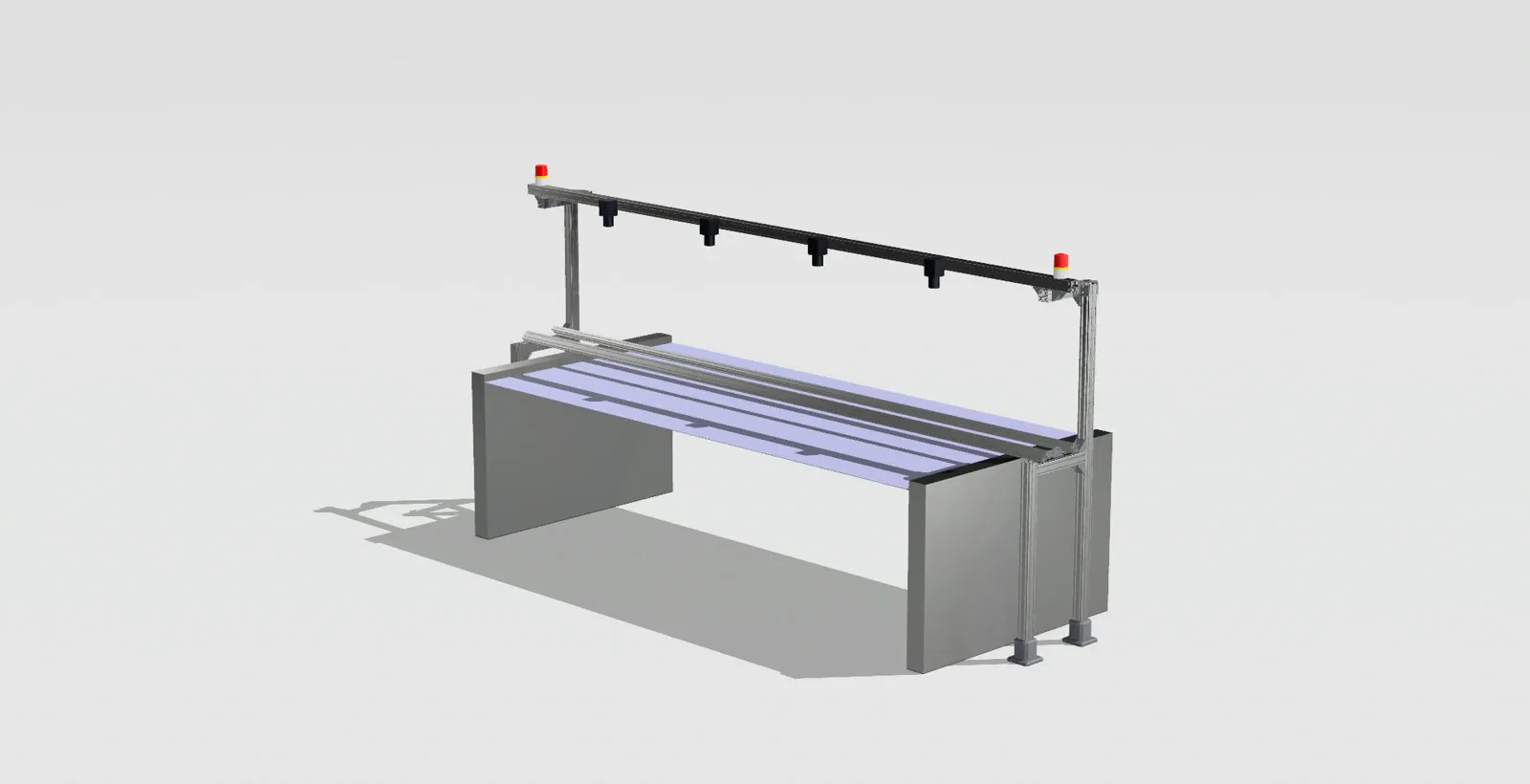
Highlights
- Continuous inline inspection along the stenter line, replacing long hours of manual visual inspection
- High frame rate imaging + classic vision + deep learning to detect and grade multiple fabric defect types
- Inspection and automatic marking run together, so downstream processes can cut, avoid or re-check
- Defect snapshots, position, shift and roll number are stored and traceable
- Packing prompts based on the current length, reducing packing mistakes
- 10 systems running on site, operating stably for more than a year and a half
Overview
Mosquito nets and mesh fabrics go through warping, weaving, dyeing and stenter finishing. Raw material variation, machine condition, process parameters and operator handling can all cause defects such as crescent marks, scars, holes, pulled threads, snowflake spots, color spots and poor joints. When quality relies mainly on downstream or post-roll sampling, problems often surface only after a large batch is produced, leading to rework, downgrading and customer complaints.
Manual inspection has clear limits on fast, continuous lines: staring at fine mesh and faint flaws for long periods causes fatigue, which leads to missed and false detections; different shifts and inspectors judge “minor, can pass” and “serious, must handle” differently; and inspection posts require a lot of labor.
The Stenter Fabric Defect Inspection System is installed at the stenter or other finishing stations. It images the tensioned, moving fabric inline and uses machine vision and deep learning to detect, grade and record defects, moving quality control from after-the-fact sampling to inline control.
How it works
- Capture: time-sliced imaging of the moving fabric, with exposure, lighting and trigger timing coordinated to reduce motion blur
- Pre-process: image enhancement and region-of-interest division, with adaptive enhancement for mesh texture and weak areas
- Detect and grade: classic vision features + deep learning to classify and grade defects
- Alarm and mark: on-screen highlighting, audible and visual alarm, with synchronized marking or signal output
- Record and trace: defect snapshots, position, time and batch are stored and can be queried by shift and roll number
Compared with manual inspection
| Item | Manual offline / sampling | This system (inline vision + AI) |
|---|---|---|
| Coverage | Sampling by batch and time window | Continuous inspection along the line |
| Consistency | Affected by fatigue and subjective judgment | Fixed rules with version control |
| Records | Paper or scattered electronic records | Structured logs and defect snapshots |
| Fine defects | Easy to miss over long shifts | Stable imaging + algorithms for low-contrast, small targets |
| Marking | Manual cutting or marking after a defect is found; new defects can be missed while marking | Inspection and marking run together, with traceability |
| Staffing | Many repetitive inspection posts | Shifts to spot checks and sample maintenance |
Key features
- Live monitoring: multi-window, split-screen view of the fabric with defect areas highlighted.
- Defect classification and grading: detects and grades multiple defect types; the defect list can be refined per project.
- Audible and visual alarms: alarm strategies configurable by defect grade.
- Position: relative coordinates of each defect along and across the fabric, mapped to the roll.
- Records and statistics: defect snapshots, time and batch are stored in a structured way; filter by shift, roll number and type, with report export extendable per project.
- Packing prompts: prompts operators to pack based on the current length, and can be linked to roll diameter, work orders or takt time.
- Permissions and logs: operators and parameter changes are traceable.
- Model maintenance: incremental samples and threshold releases, with small-sample adaptation at changeover.
Standard configuration
| Component | Description |
|---|---|
| Industrial camera | Global shutter area-scan, sharp imaging of moving fabric |
| Industrial lens | Matched to field of view and working distance |
| LED lighting | Raises contrast of yarns, mesh structure and defects; strobe optional |
| Vision controller / edge computer | Inference, communication, recording and result output |
| Mounting and protection | Anti-vibration, temperature control and dust protection for the workshop |
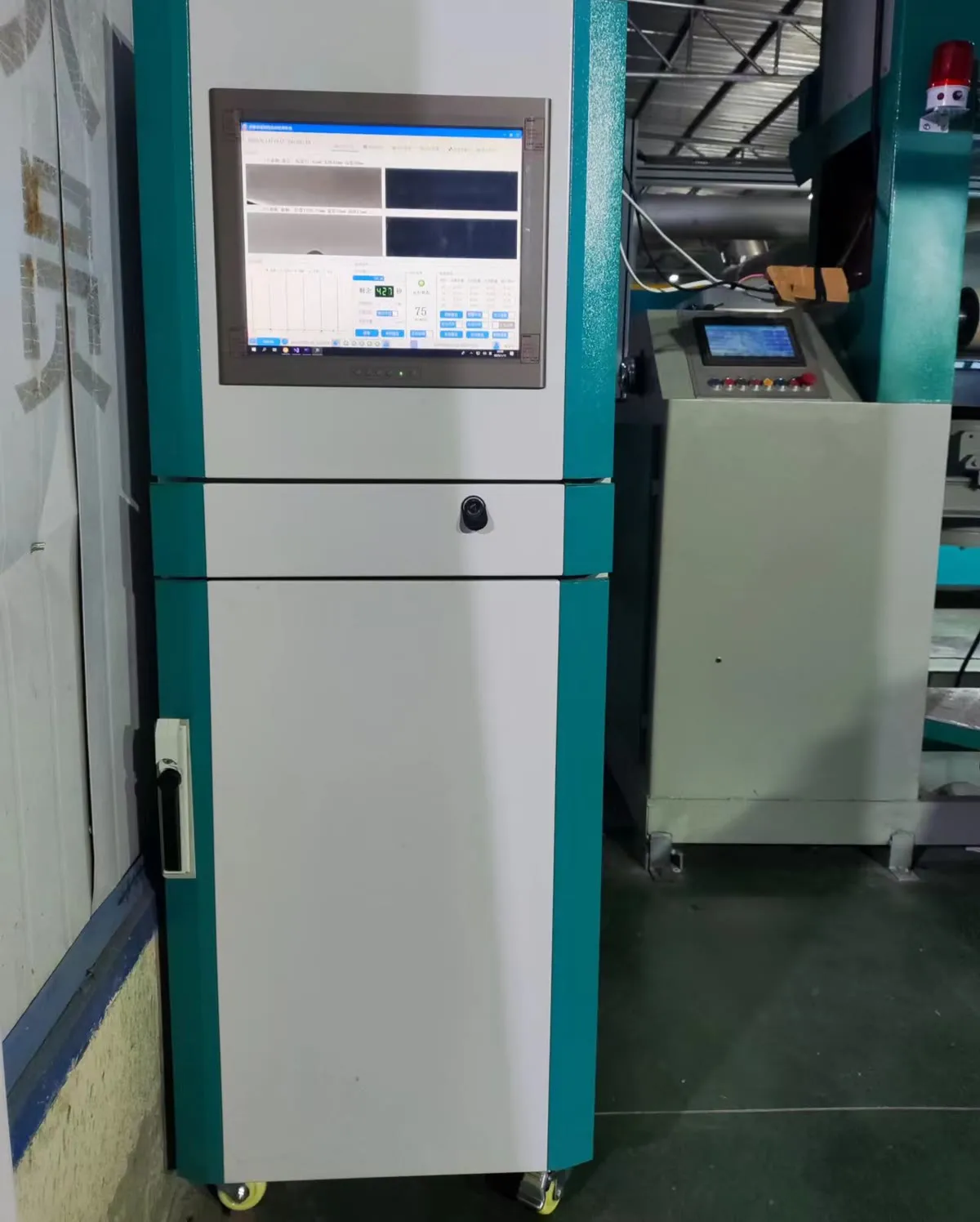
| HMI | Live monitoring, reports and parameter maintenance; touchscreen optional |
Exact models are selected after an optical calculation based on the machine, line speed, width and site conditions.
Deployment and benefits
10 systems are running on site at the stenter stage of mosquito net / mesh fabric production, operating stably for more than a year and a half.
- Automatic detection and classification: defects are detected inline and filed by type, with fixed judgment criteria that rely less on individual experience.
- Marking linked to the process: marks or signals are output per the process rules, so downstream steps can cut, avoid or re-check.
- Lighter workload: the system takes over the intensive fabric watching, and staff move to spot checks, reviews and sample maintenance.
- Less downstream loss: fewer defective sections reach cutting and sewing, reducing waste, rework and lost hours.
- Earlier quality control: defects are intercepted and graded at the stenter / inspection stage, instead of being found in finished products.
Notes
Miss rate, false detection rate and minimum detectable size depend on line speed, depth of field, oil and dust, and fabric sheen. They are verified during trial operation using defect samples provided by the customer, and final figures are based on the technical agreement and site acceptance. Send us your line speed, width, fabric type and defect list, and we will provide an optical calculation and implementation proposal.
Gallery
Related products
 Product video1:34
Inspection Systems
Yarn Break Inspection System for Laminating Machines
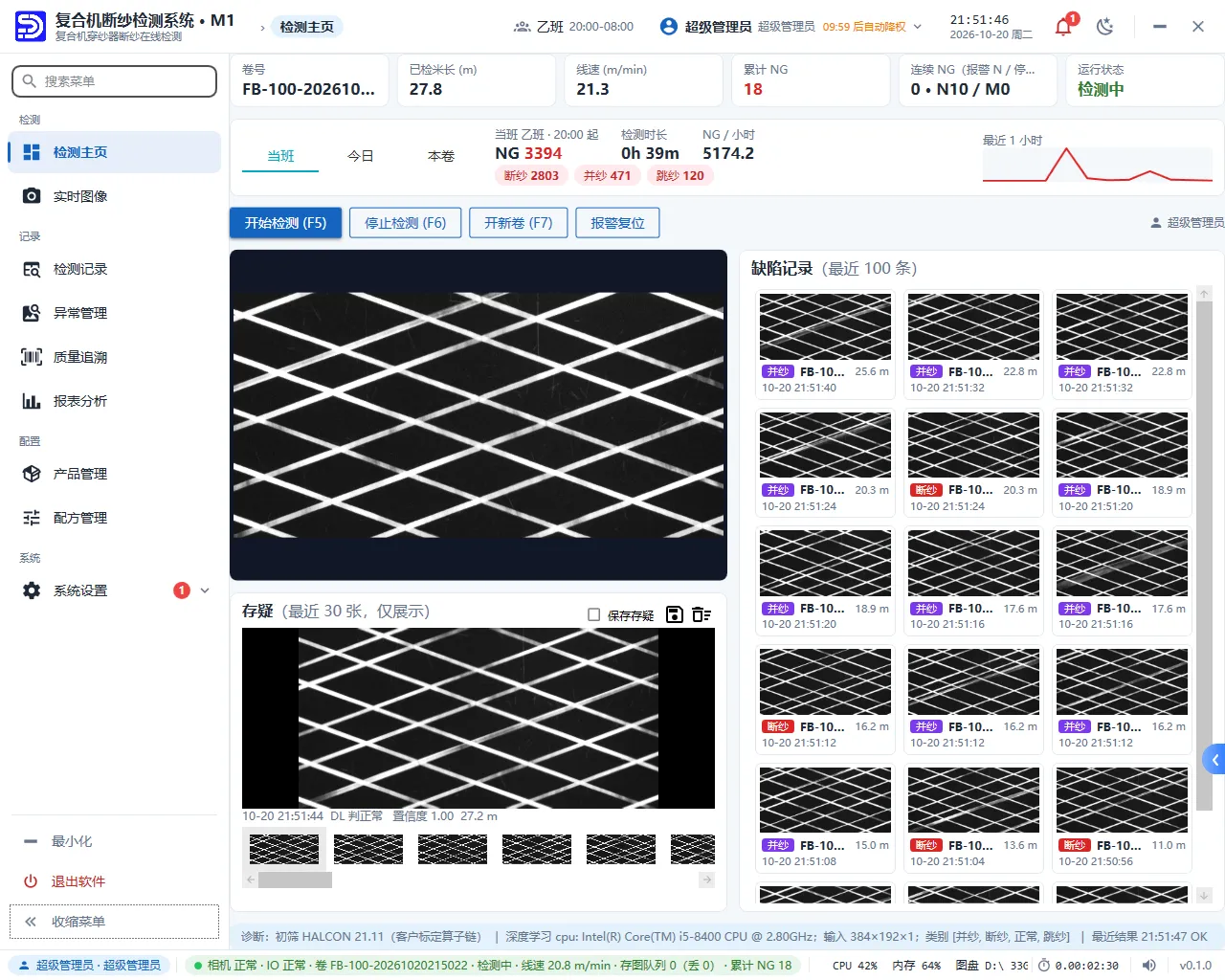
Installed at the yarn guide station of a laminating machine, it uses an industrial camera and vision algorithms to detect broken, merged and skipped yarns in fiberglass / polyester scrim inline, triggers alarms and machine stops, and keeps full roll-level traceability.
- Line speed
- 0–20 m/min
- Alarm response
- ≤100 ms
Details
Inspection Systems
UD Fabric Online Defect Inspection System
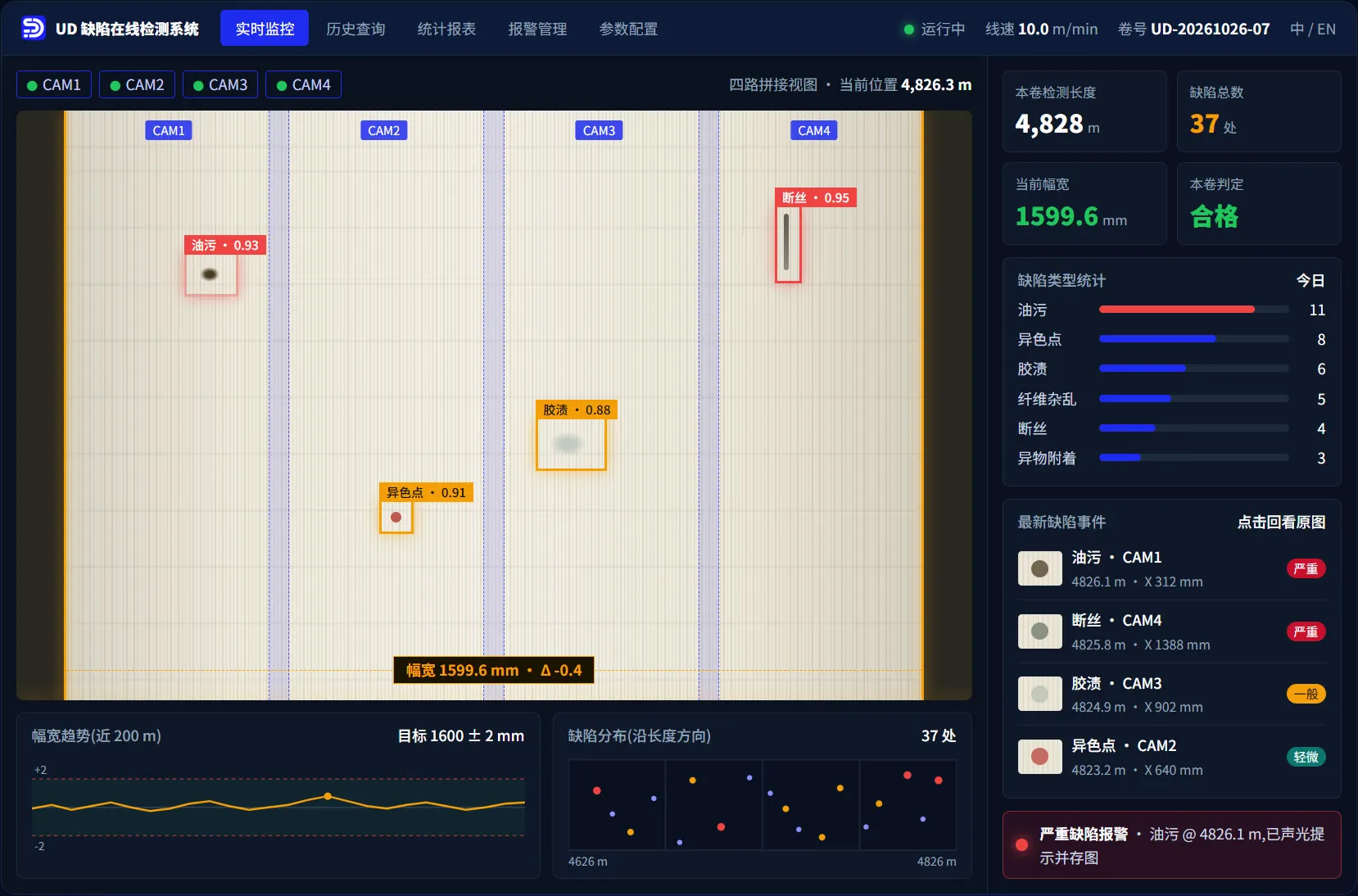
For continuous unidirectional (UD) fabric lines, 4 stitched cameras image the full width while machine vision and deep learning inspect surface defects and measure width at the same time, with real-time alarms and meter-based traceability, replacing manual sampling.
- Fabric width
- About 1.6 m
- Pixel size
- About 0.2 mm/pixel
Details
Inspection Systems
Glass Fiber Yarn Unwinding Inspection System
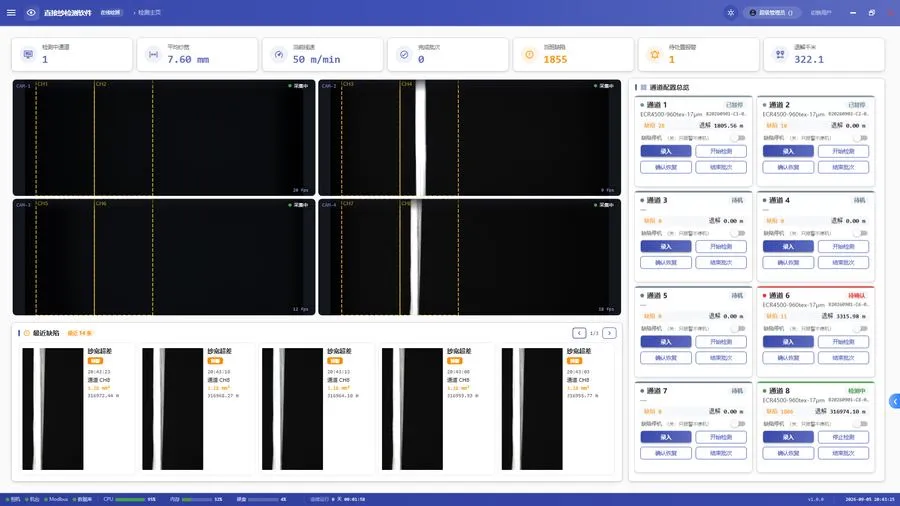
Inline appearance inspection for the unwinding of glass fiber direct roving and assembled yarn. It detects broken yarn, large fuzz balls, out-of-tolerance width and more, stops the winder, and records defect length positions and images by batch.
- Line speed
- 100 m/min and above
- Capture rate
- About 50 frames/s
Details
Have an inspection challenge?
Tell us about your product and requirements. Our engineers will assess feasibility.