Inspection Systems
UD Fabric Online Defect Inspection System
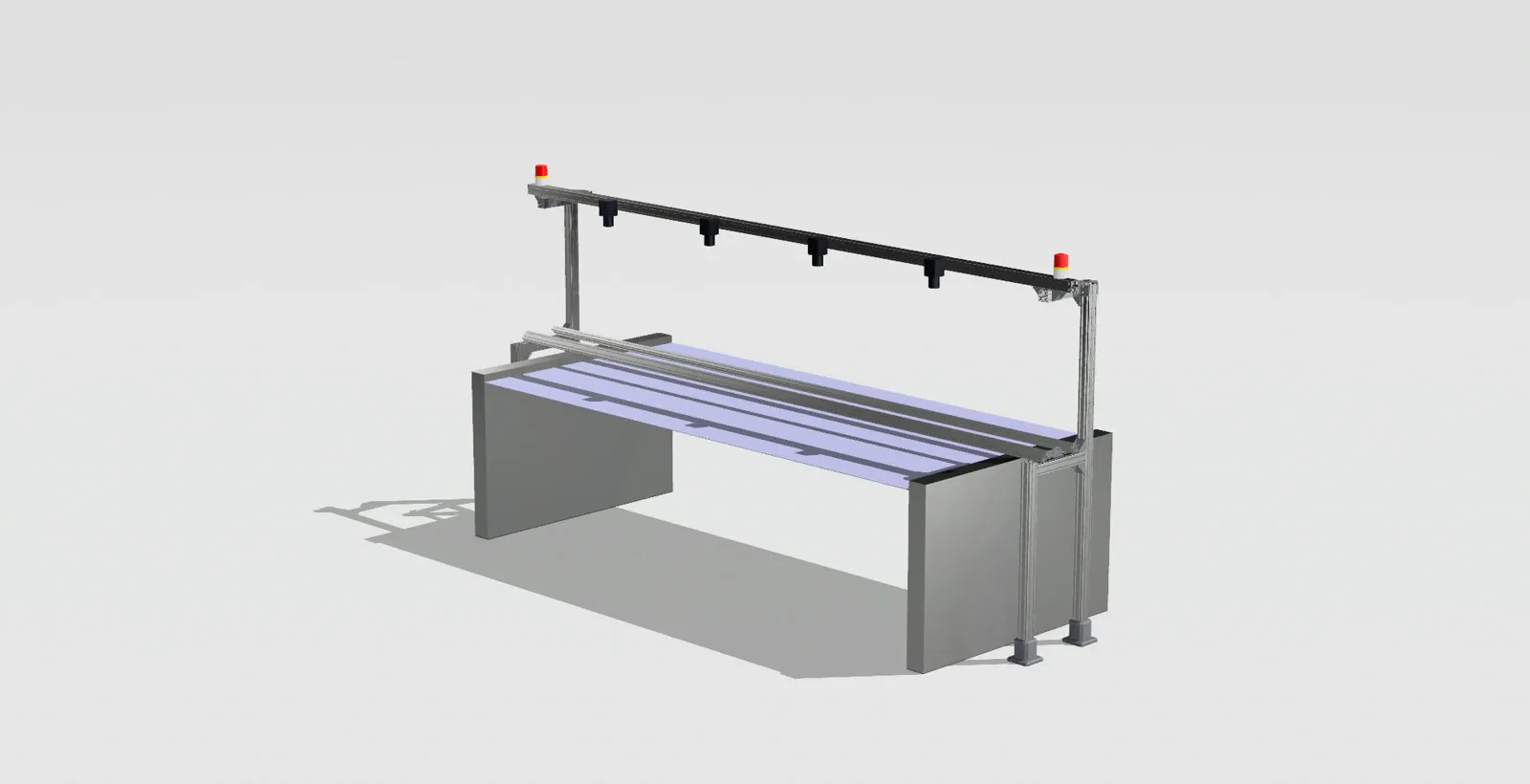
For continuous unidirectional (UD) fabric lines, 4 stitched cameras image the full width while machine vision and deep learning inspect surface defects and measure width at the same time, with real-time alarms and meter-based traceability, replacing manual sampling.
Highlights
- 4 × 5 MP global-shutter color cameras stitched across about 1.6 m of fabric width
- About 0.2 mm/pixel, in-plane defects of ≥1 mm detectable
- Deep learning identifies 10 defect types; accuracy ≥99%, miss rate ≤0.8%, false alarm rate ≤1%
- Sub-pixel edge detection measures width online to ±2 mm, sharing the same imaging system
- Graded audible/visual and voice alarms, ≤100 ms response, serial link to the stenter
- Meter mark, cross position, type and original image recorded for every defect; reports export to Excel / CSV
Overview
UD fabric is widely used in high-performance composites for ballistic protection, aerospace and construction reinforcement. Surface quality and width consistency directly affect downstream layup, impregnation and mechanical performance. Manual sampling faces several problems:
- Wide fabric, many blind spots: at 1.6 m wide, the eye cannot keep covering the whole width, and attention drops over long shifts.
- Small defects are missed: defects of ≥1 mm such as broken filaments and off-color spots look similar to the fiber texture, so visual judgment is inconsistent.
- Width checks lag behind: width is re-measured by tape, so by the time an out-of-tolerance is found, a long section has already been produced.
- Hard to trace quality: defect positions, types and counts are not recorded digitally, leaving little basis for process improvement.
The UD Fabric Online Defect Inspection System replaces manual sampling with machine vision and deep learning. 4 stitched cameras image the full width, inspecting surface defects and width together, with real-time recognition, immediate alarms and full traceability.
Compared with manual sampling
| Item | Manual sampling | Online inspection |
|---|---|---|
| Coverage | Sampling, limited | Continuous full width, overlapping camera views |
| Scope | Defects and width checked separately | Defects + width inspected together |
| Consistency | Varies by operator | Uniform algorithm criteria, automatic classification |
| Width measurement | Tape re-measurement, delayed | Online ±2 mm, alarm on out-of-tolerance |
| Traceability | Difficult | Meter mark + cross position + image, reviewable |
| Quality statistics | Manual records | Automatic statistics, export to Excel / CSV |
Key advantages
Designed for UD fabric, where fibers run parallel in one direction and the light-colored surface reflects easily.
- Full width with 4 stitched cameras: about 10,000 pixels across, more than the 8,000 pixels needed for 1.6 m; adjacent views overlap by about 10% to avoid missed defects at the seams.
- High-resolution detection: about 0.2 mm/pixel, in-plane defects of ≥1 mm detectable; global shutter with encoder-synchronized triggering reduces motion blur and line misalignment.
- AI recognition and classification: a YOLO-type deep learning detector with adaptive pre-processing for unidirectional texture covers holes, broken filaments, oil stains, resin spots, wrinkles and more, classified automatically.
- Sub-pixel width measurement: Canny / sub-pixel edge detection locates both fabric edges and computes width with encoder compensation, using the same imaging system as defect inspection with no extra gauge.
- Custom lighting against glare: uniform LED line lights, backlight assisted by front light, suppress fiber reflection while keeping both defect contrast and edge profile.
- Graded alarms and line integration: severe defects or width out-of-tolerance trigger audible/visual alarms and voice prompts; serial communication with the stenter, with optional PLC / alarm interlock, designed to keep the existing line rhythm.
Architecture
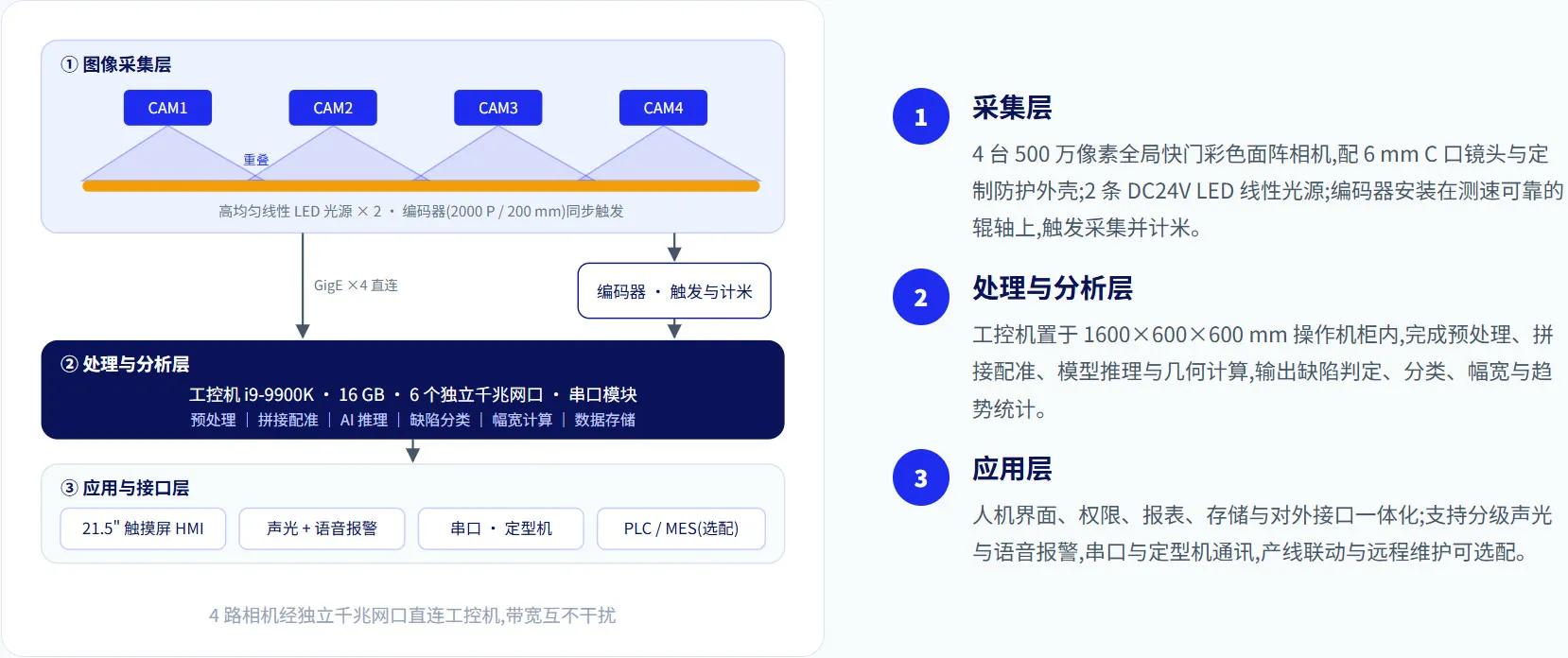
- Image acquisition: 4 × 5 MP global-shutter color area cameras with 6 mm C-mount lenses and custom housings; 2 DC24V LED line lights; an encoder on a reliably rotating roller triggers capture and counts meters.
- Processing and analysis: the 4 cameras connect directly to the industrial PC through independent gigabit ports with no shared bandwidth; the PC sits in a 1600 × 600 × 600 mm control cabinet and handles pre-processing, stitching and registration, model inference and geometry calculation, outputting defect results, classes, width and trend statistics.
- Application and interfaces: HMI, user access, reports, storage and external interfaces in one platform; graded audible/visual and voice alarms, serial link to the stenter, with optional PLC / MES integration and remote maintenance.
Workflow
- Synchronized capture: the encoder triggers all 4 cameras at once
- Pre-processing and stitching: denoising, gray-level balancing, texture suppression and edge enhancement, then registration and stitching of the 4 images
- AI detection and classification: deep learning detects surface defects and assigns defect types
- Width measurement: sub-pixel location of both edges with encoder compensation, ±2 mm
- Judgment and traceability: severe defects or out-of-tolerance trigger alarms; results, images and run data are stored
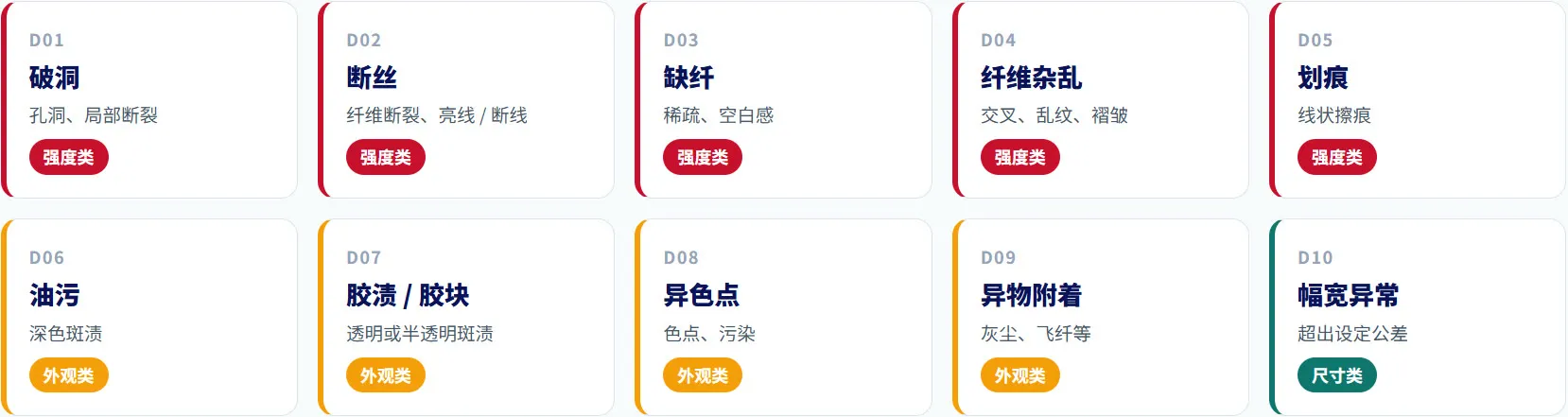
10 defect types, grouped by impact
Alarm levels and responses can be set in the software according to process requirements.
| Group | Defects |
|---|---|
| Strength | Hole, broken filament, missing fiber, fiber disorder (crossing / irregular texture / wrinkle), scratch |
| Appearance | Oil stain, resin spot / lump, off-color spot, foreign matter (dust, fly fiber, etc.) |
| Dimension | Width out of tolerance |
For acceptance, standard defect samples ≥1 mm wide and ≥10 mm long in the running direction are recommended, to reduce confusion with fiber texture and slight wrinkles. New materials and specifications can be adapted with additional samples and recalibration.
Software
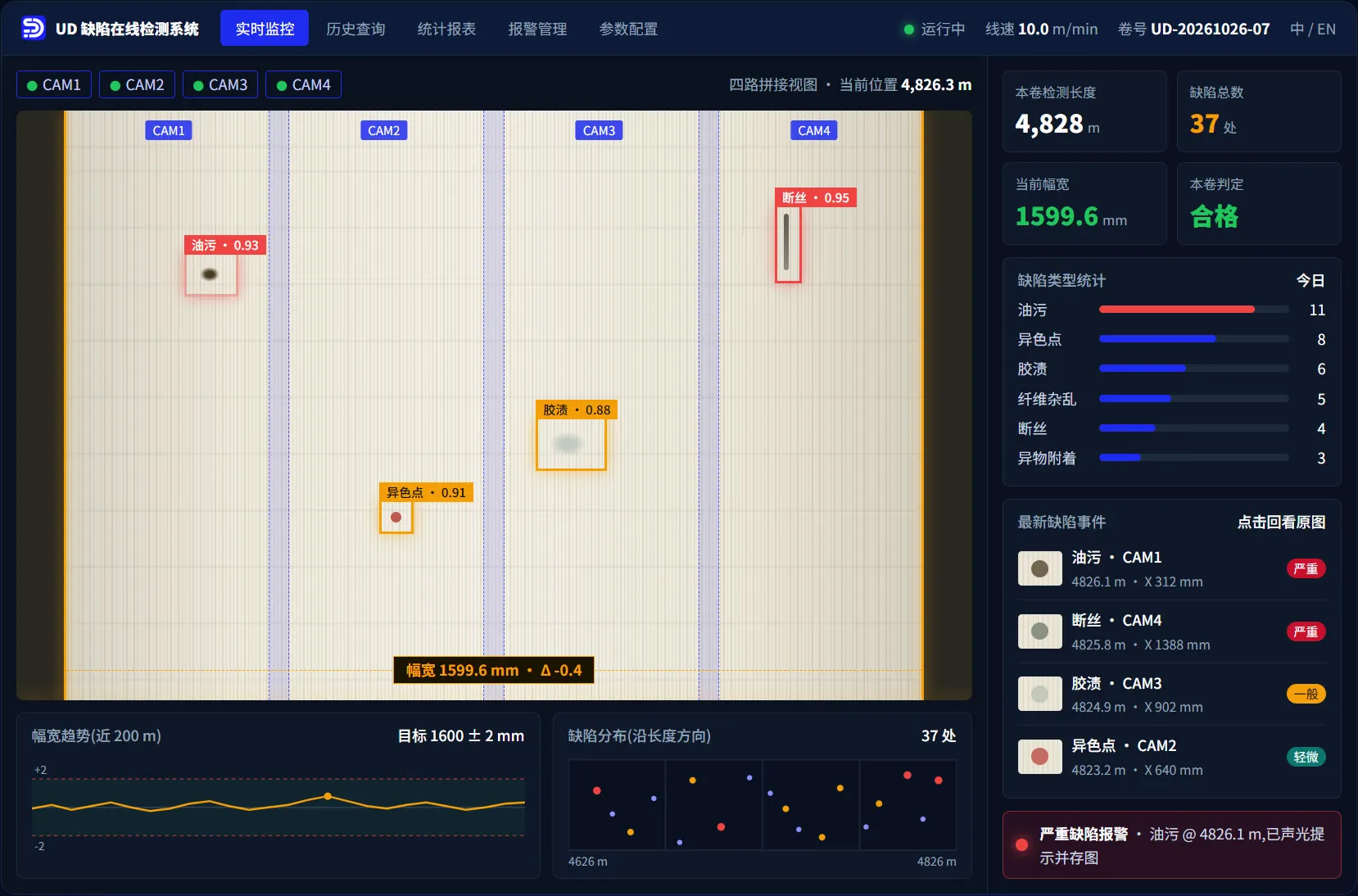
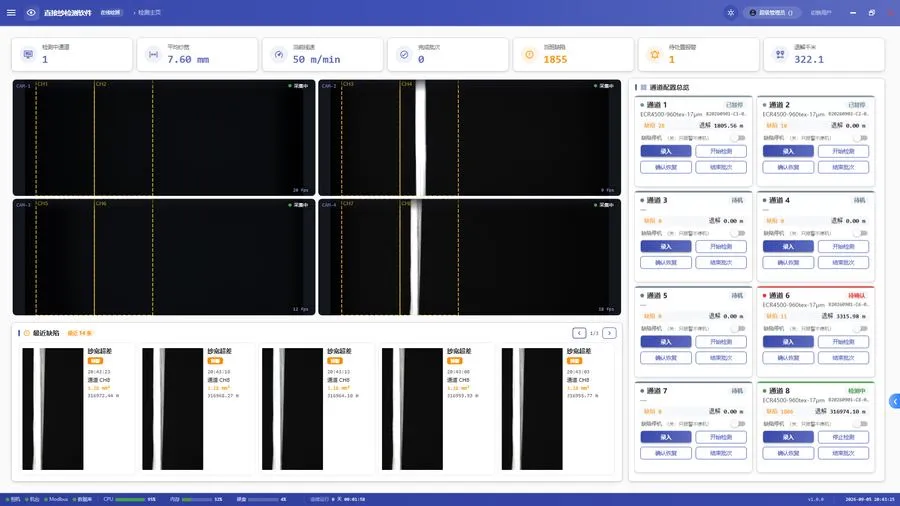
A dark industrial interface suited to long shifts, operated on a 21.5-inch touchscreen, with Chinese / English switching.
- Live monitoring: the 4 stitched views shown in real time with defects boxed and labeled; edges, width and meter mark always visible.
- History: filter by roll number, time and defect type; view original images, positions and meter marks.
- Reports: defect type distribution and width trends, generated automatically and exported to Excel / CSV.
- Alarm management: graded alarms for severe defects and width out-of-tolerance, linked to alarm lights and voice prompts, with alarm records.
- Calibration and parameters: multi-camera calibration, recipe switching, defect thresholds and width tolerance adjustable, with batch-level fine tuning after go-live.
- Access and self-test: tiered user access, power-on self-test and run logs, online monitoring of cameras and lighting.
Delivery and service
Requirements analysis, design, hardware procurement, system integration and CE certification run in parallel, with a total lead time of 30 days from contract effect. Installation and commissioning are guided remotely, and algorithm parameters keep being optimized after go-live. Warranty of ≥12 months from acceptance covers hardware and software defects; support by phone, email and remote troubleshooting, with on-site visits for major issues per contract; training for operators, maintenance and technical staff, plus operation and maintenance manuals.
Notes
The above is the standard configuration; width, speed and other parameters can be recalculated for site conditions. Accuracy, miss and false alarm rates depend on a mutually agreed defect sample library and statistical rules, and are subject to site acceptance. Software screenshots are illustrations; the final interface is subject to the delivered software.
Gallery
Related products
 Product video1:34
Inspection Systems
Yarn Break Inspection System for Laminating Machines
Installed at the yarn guide station of a laminating machine, it uses an industrial camera and vision algorithms to detect broken, merged and skipped yarns in fiberglass / polyester scrim inline, triggers alarms and machine stops, and keeps full roll-level traceability.
- Line speed
- 0–20 m/min
- Alarm response
- ≤100 ms
Details
Inspection Systems
Stenter Fabric Defect Inspection System
Installed at the stenter or other finishing stations, it uses industrial cameras, LED lighting and deep learning to detect holes, pulled threads, color spots and other defects on mosquito net greige and mesh fabric inline, with graded alarms, automatic marking and roll-level traceability.
Details
Inspection Systems
Glass Fiber Yarn Unwinding Inspection System
Inline appearance inspection for the unwinding of glass fiber direct roving and assembled yarn. It detects broken yarn, large fuzz balls, out-of-tolerance width and more, stops the winder, and records defect length positions and images by batch.
- Line speed
- 100 m/min and above
- Capture rate
- About 50 frames/s
Details
Have an inspection challenge?
Tell us about your product and requirements. Our engineers will assess feasibility.