Inspection Systems
Natural Casing Appearance Inspection System
Replaces manual visual inspection with 360° backlit transmission imaging of shirred natural casings. It detects hair, foreign matter, holes, stains and more, rejects by severity, and records every casing for traceability.
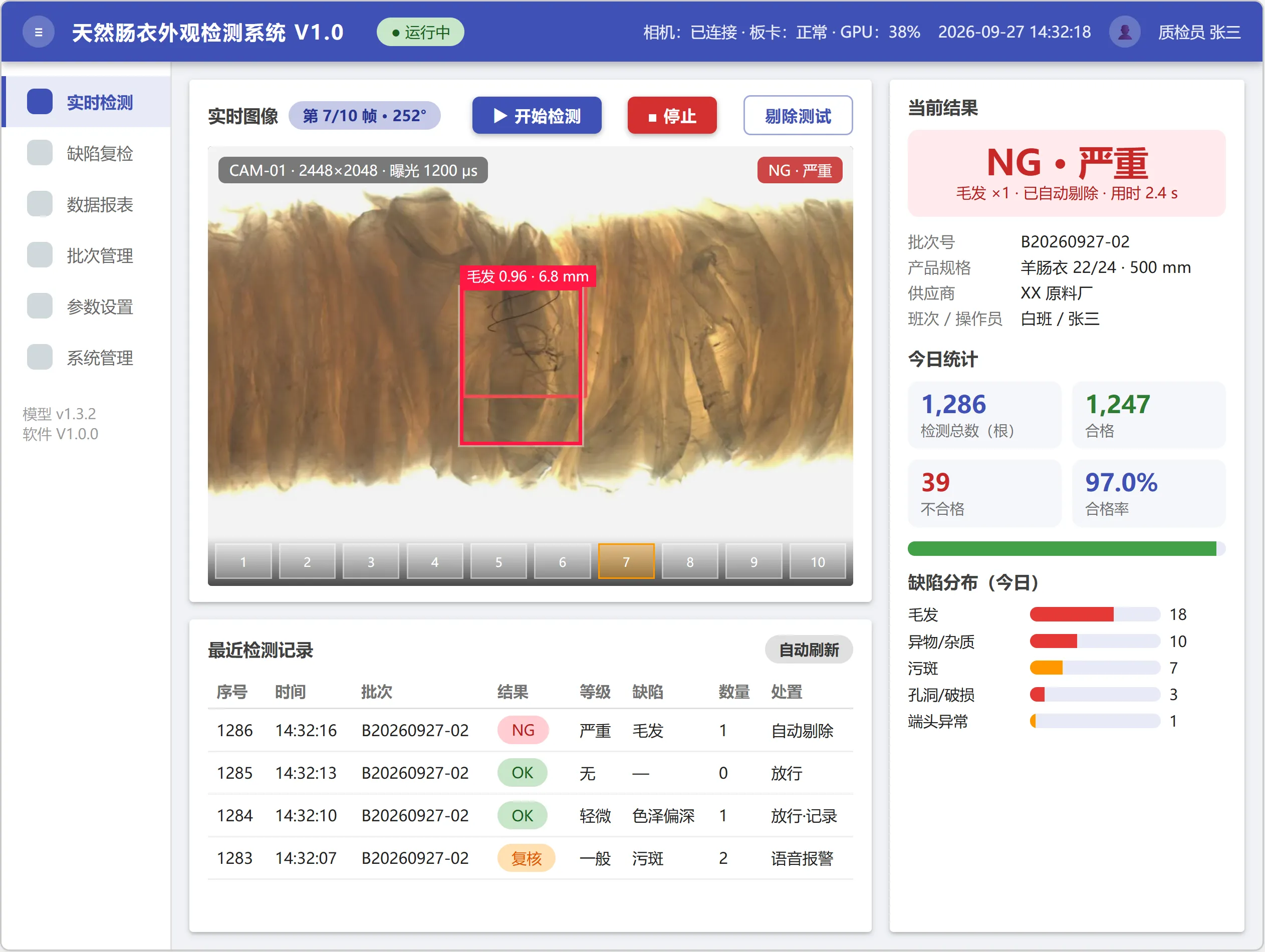
Highlights
- Casing rotates 360° with multi-frame capture covering the full circumference and length, stitched into an unrolled image
- Backlit transmission imaging detects hair / foreign matter ≥0.5 mm (target)
- Cycle time ≤3 s per casing, about 1,200 casings per hour (target)
- Four severity levels; severe defects trigger alarms and are diverted to the NG bin automatically
- Hopper holds 10–20 casings with automatic singulation; one operator can tend several machines
- Results and defect images saved per casing, with multi-dimensional reports exported to Excel / PDF
Overview
Cleanliness and integrity are key acceptance criteria for natural casings. Today, casing appearance inspection still relies largely on manual visual checks, which brings several problems:
- Subjective judgment: standards depend on experience and vary between people and shifts
- Missed and false detections: fine, low-contrast defects such as hair are hard to see, and fatigue sets in over long shifts
- Low efficiency: each casing is turned by hand in 6–10 seconds with large variation, so peak seasons need more staff
- No traceability: results are neither recorded nor analyzed, so complaints cannot be traced
The Natural Casing Appearance Inspection System replaces manual inspection with machine vision and AI, handling loading, inspection, grading, rejection and recording on a single machine.
How it works
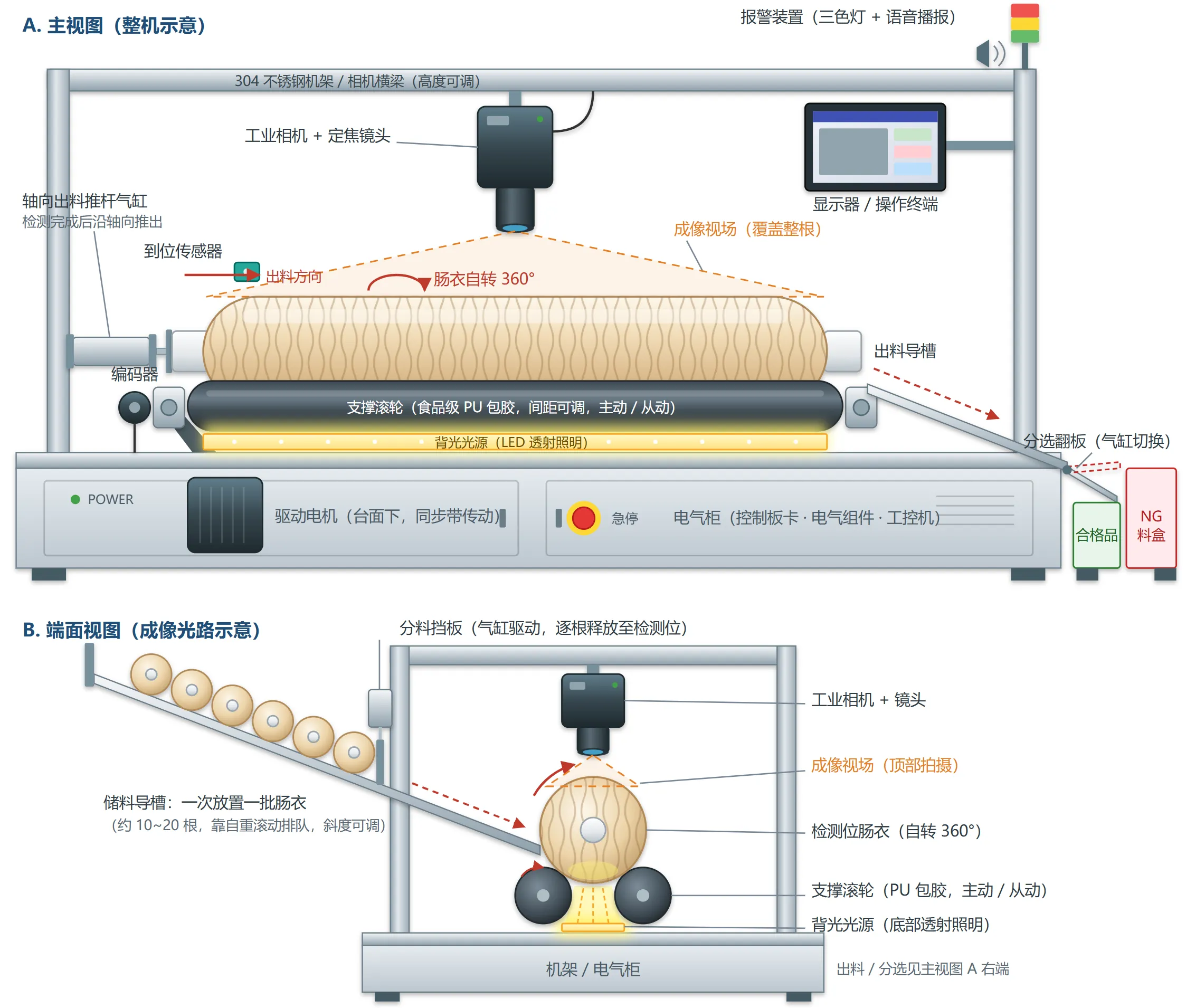
The system consists of an inspection mechanism, an industrial camera with backlight, control boards and electrical components, a high-performance industrial PC and inspection software.
- Batch loading and singulation: load 10–20 casings at a time; they queue in the hopper chute by gravity and a gate releases them one by one to the inspection position. The operator only needs to refill periodically.
- One rotation, transmission imaging: the casing rotates 360° on food-grade rollers while an encoder triggers multi-frame capture, with LED backlight shining through the membrane.
- Judgment and sorting: defects are identified and graded in real time; an axial pusher moves the casing into the discharge chute, and a diverter sends it to the OK or NG bin.
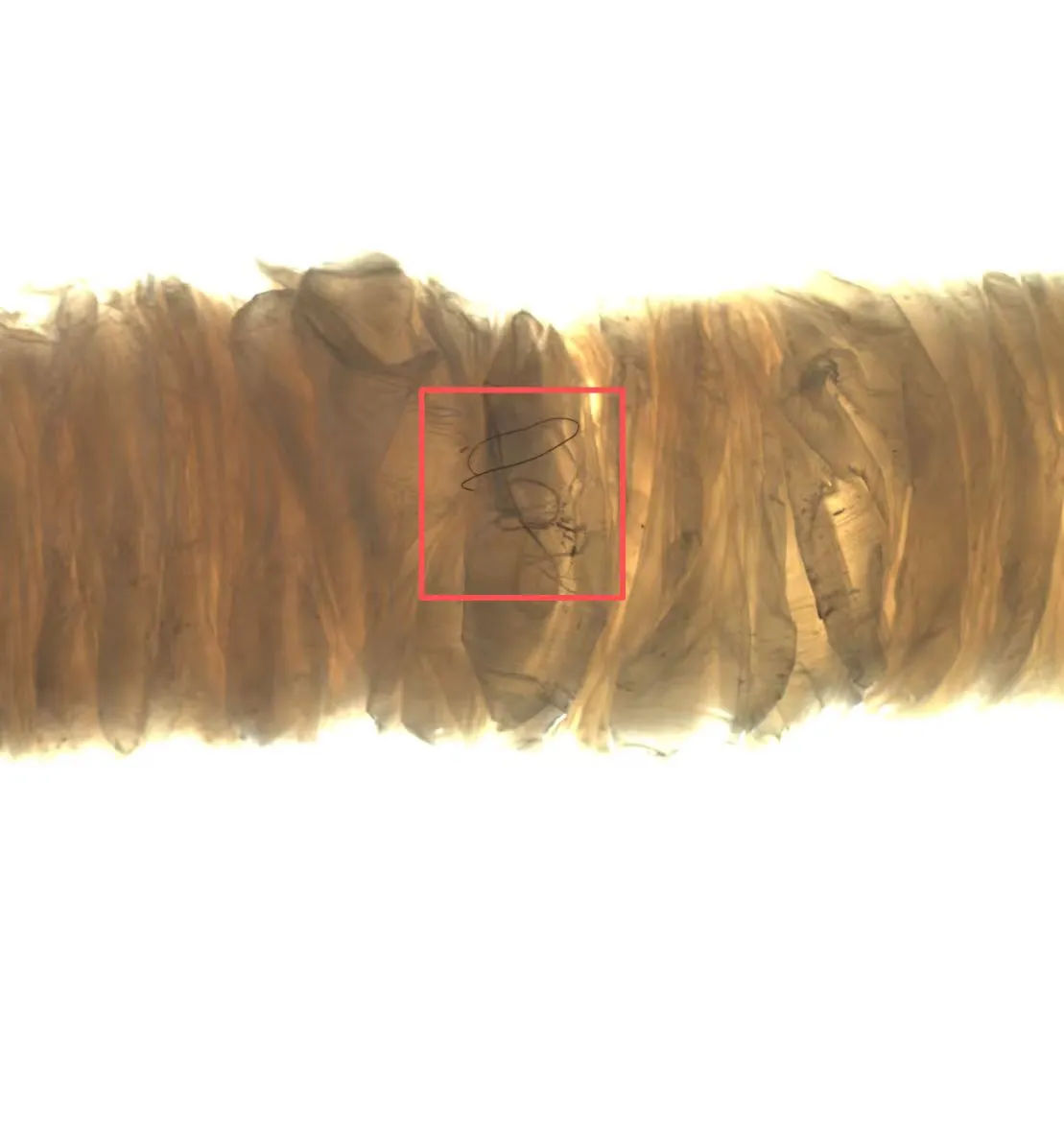
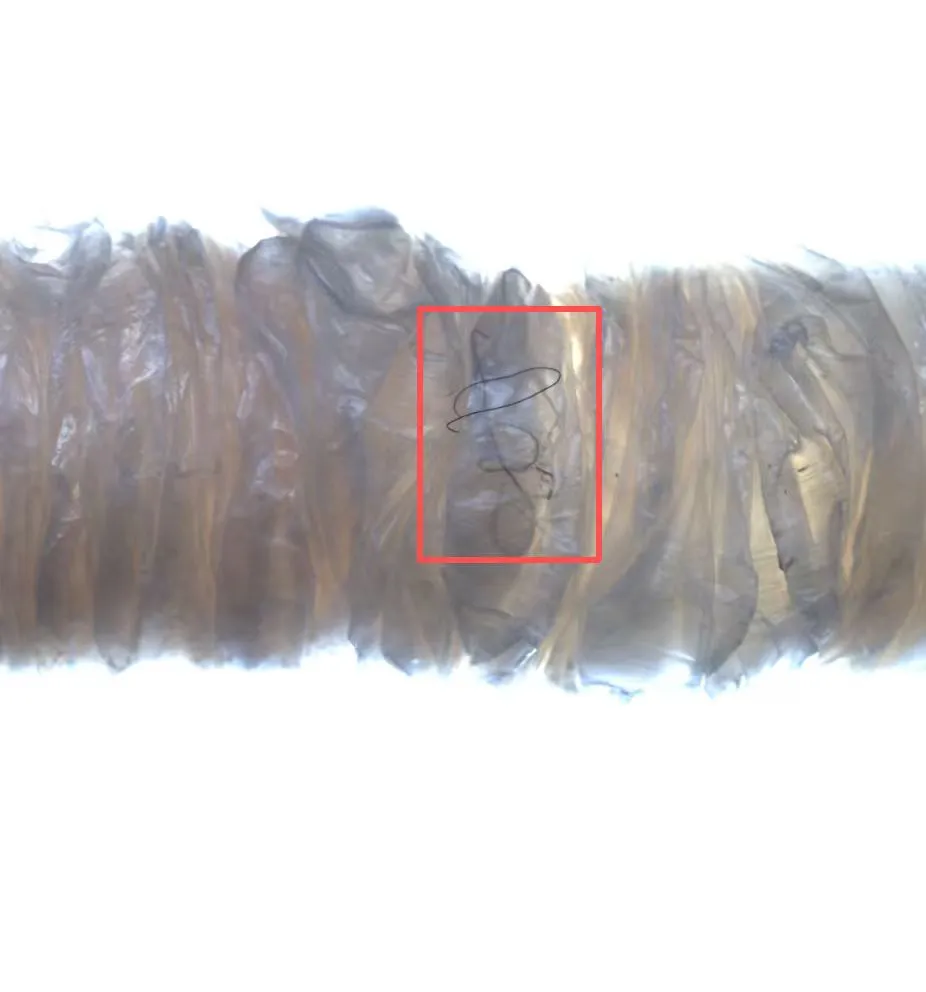
Natural casing is a semi-transparent multi-layer membrane. Under backlit transmission, normal membrane shows an even light texture; hair, foreign matter and stains block light and appear as clear dark targets, while holes and tears appear as abnormal bright areas, giving higher defect contrast than ordinary reflected-light imaging.
Detectable defects
Hair, foreign matter / impurities, holes / tears, stains / blood spots, fat residue, end defects, color abnormalities, uneven or loose shirring, and other user-defined defects. Severity and size thresholds for each defect type can be set in the software by product grade.
| Level | Typical defects | Handling |
|---|---|---|
| OK | No defects, or only slight color / shirring deviation | Green light, counted and passed |
| Moderate | Stains, fat, end defects, etc. | Voice prompt + on-screen notice for manual review |
| Severe | Hair, foreign matter, holes / tears (default) | Audible and visual alarm, diverted to NG bin |
Software
Chinese-language interface with touchscreen support; results are shown with colored blocks and voice prompts, and operators can get started after brief training.
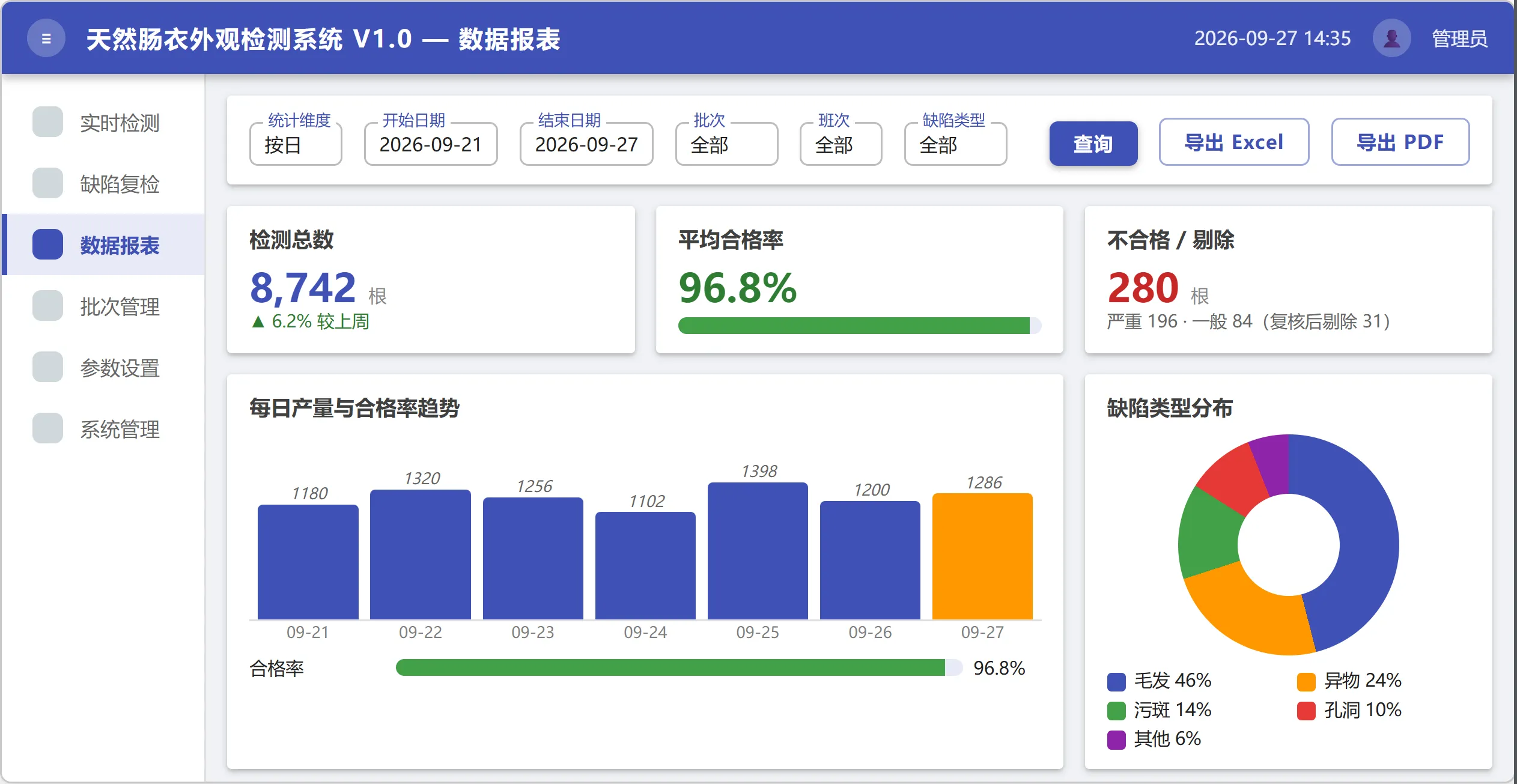
- Live inspection: live image with defect marking, current result, batch information, daily statistics and defect distribution
- Defect review: review images from any angle and the 360° unrolled image, mark false or missed detections in one click; review results are collected as samples for periodic model updates
- Reports: statistics by day / shift / batch / supplier / defect type, exported to Excel / PDF
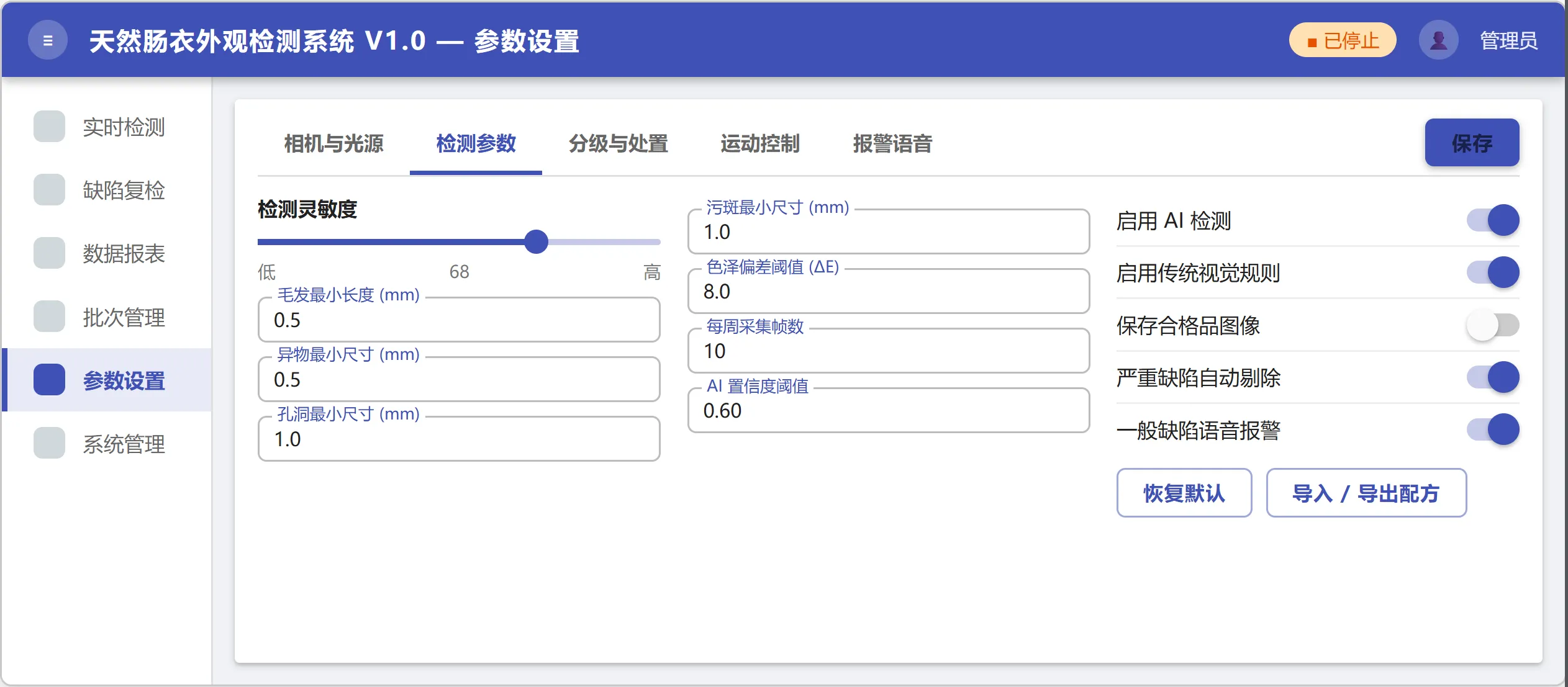
- Recipes: sensitivity, thresholds and grading actions, with recipe import and export
- Batch management: switch batches by barcode scan, linked to supplier, specification and operator
- Role-based permissions: operator / QC / administrator, with logs of key operations
- Integration: optional MES / ERP interface and label printing
Standard configuration
| Component | Description |
|---|---|
| Inspection mechanism | Hopper chute, singulation gate, roller rotation mechanism, encoder, discharge and sorting mechanism, 1 set |
| Industrial camera | 5 MP industrial camera + fixed-focus lens + LED backlight, 1 set |
| Alarm | Three-color tower light + voice module, 1 set |
| Control boards | Motion / trigger / IO control boards, 1 set |
| Electrical | Electrical cabinet, power supply, drives, pneumatic components, emergency stop, 1 set |
| Display | 21.5-inch industrial display (touch optional), 1 unit |
| Industrial PC | Multi-core CPU / dedicated GPU / SSD, Windows 10/11, 1 set |
| Software | Natural Casing Appearance Inspection System software V1.0, with AI recognition and initial inspection model, 1 set |
Options: automatic loading and unloading conveyor, touchscreen / shop-floor dashboard, MES / ERP interface, barcode batch traceability, remote maintenance service, centralized management of multiple machines.
Implementation and service
- Sample testing: the customer provides typical samples, and we deliver an imaging and detection capability assessment report
- Custom delivery: after the defect standards and configuration are confirmed, manufacturing, integration and factory acceptance take about 10 weeks
- Installation and training: on-site installation, commissioning, operation and maintenance training, with acceptance after a trial run
We handle manufacturing, on-site installation and commissioning, model training on samples and operator training. The first 3 months after go-live are a model optimization period, during which detection and false alarm rates are tuned until the acceptance criteria are met.
- 12-month machine warranty, with lifetime software bug fixes
- Phone / remote response within 30 minutes, 7×12 hours
- On-site service within 48 hours (outside Shaanxi)
- 1 year of free software upgrades and model optimization
Figures are targets; final values are based on sample testing and acceptance, and specifications are subject to the technical agreement.
Gallery
Related products
 Product video1:34
Inspection Systems
Yarn Break Inspection System for Laminating Machines
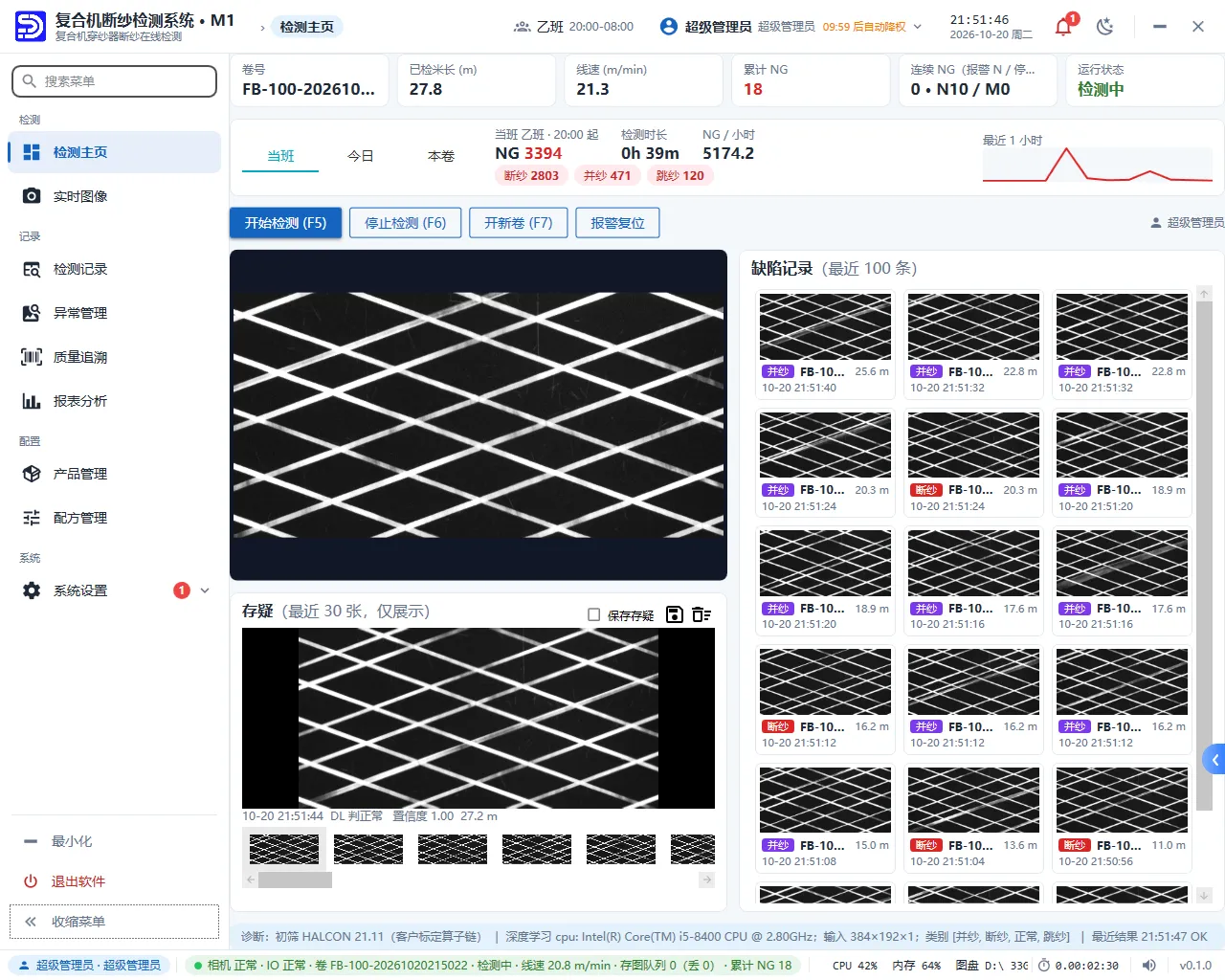
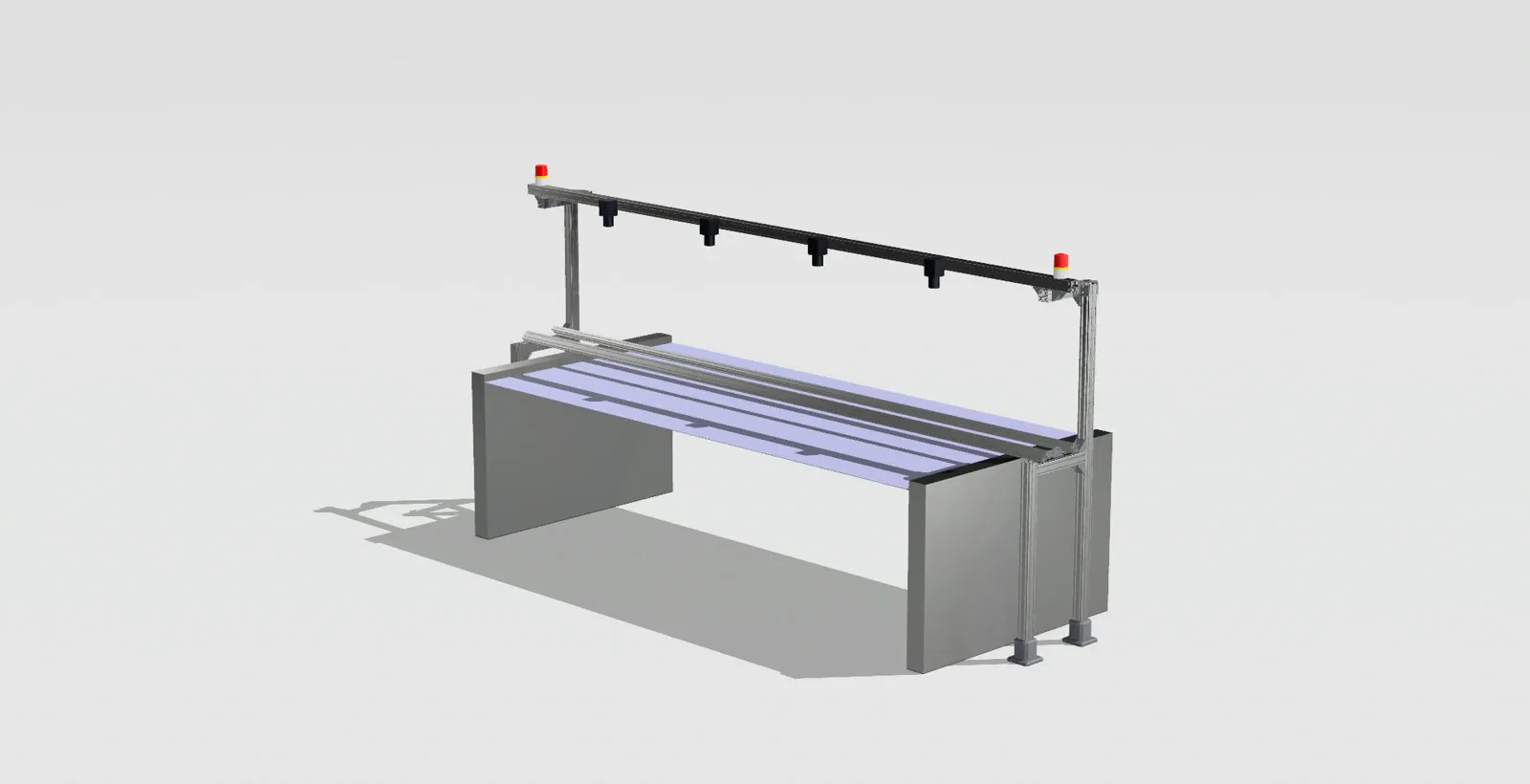
Installed at the yarn guide station of a laminating machine, it uses an industrial camera and vision algorithms to detect broken, merged and skipped yarns in fiberglass / polyester scrim inline, triggers alarms and machine stops, and keeps full roll-level traceability.
- Line speed
- 0–20 m/min
- Alarm response
- ≤100 ms
Details
Inspection Systems
Stenter Fabric Defect Inspection System
Installed at the stenter or other finishing stations, it uses industrial cameras, LED lighting and deep learning to detect holes, pulled threads, color spots and other defects on mosquito net greige and mesh fabric inline, with graded alarms, automatic marking and roll-level traceability.
Details
Inspection Systems
UD Fabric Online Defect Inspection System
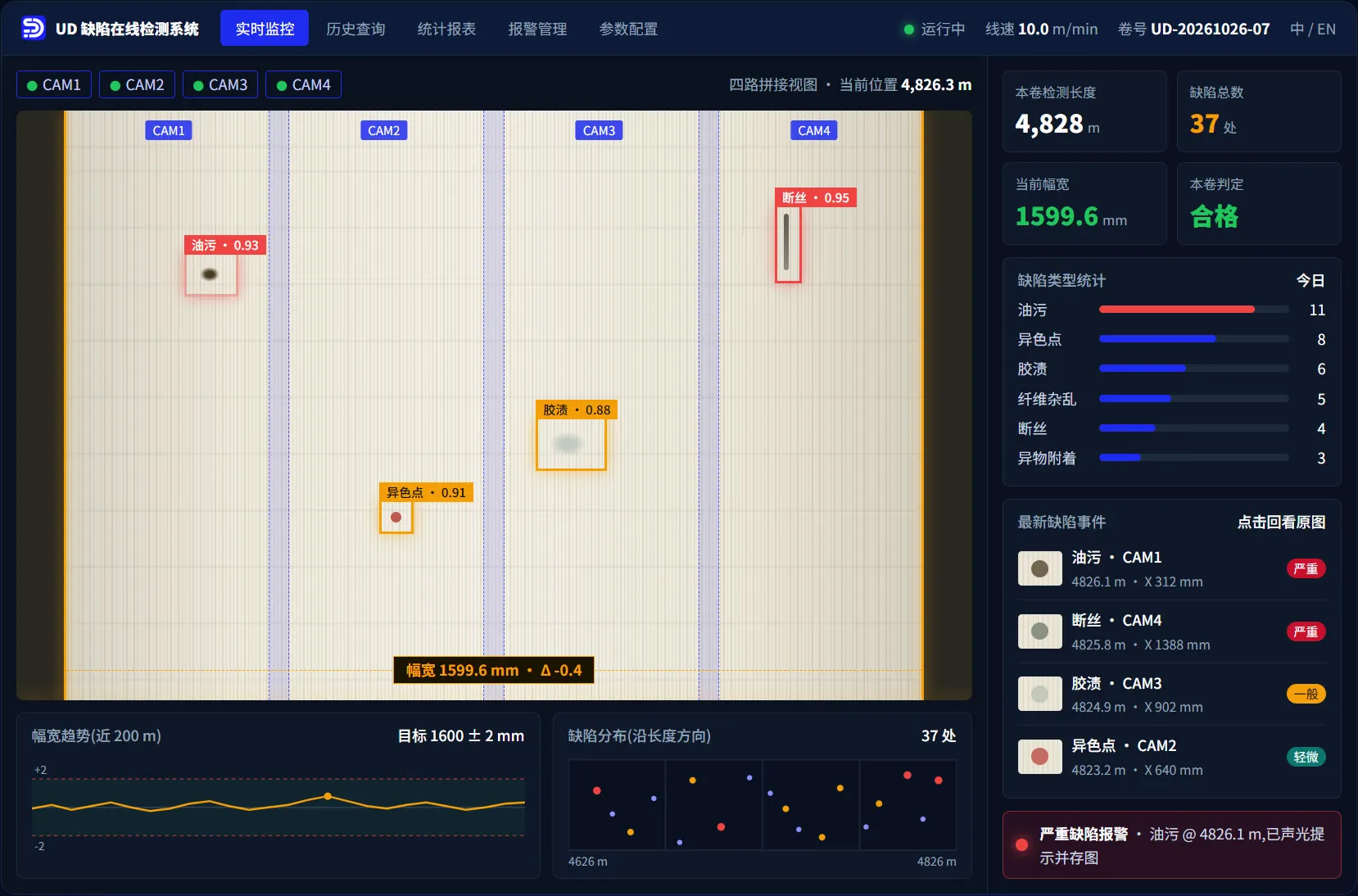
For continuous unidirectional (UD) fabric lines, 4 stitched cameras image the full width while machine vision and deep learning inspect surface defects and measure width at the same time, with real-time alarms and meter-based traceability, replacing manual sampling.
- Fabric width
- About 1.6 m
- Pixel size
- About 0.2 mm/pixel
Details
Have an inspection challenge?
Tell us about your product and requirements. Our engineers will assess feasibility.